The UMD small grain variety trial data are now available. Click here to view the report, or contact your local ag agent the Extension Office for a hard copy. Information is intended to help growers select the best wheat and barley varieties for the 2020 crop. Additional variety data on DON vomitoxin will be posted to this page soon.
Tag: small grain
2019 Corn, Soybean, and Small Grain Fungicide Recommendations
Andrew Kness, Agriculture Agent
University of Maryland Extension, Harford County
As we get into the swing of the 2019 growing season, it can be helpful to have access to a quick reference for fungicide recommendations for if/when diseases become a problem on your farm. As you are aware, there are several products available for disease management and it can be difficult and confusing to select the appropriate product. Also remember that just because a pesticide is labeled for use on a particular crop to manage a specific pest, does not necessarily mean or guarantee that the pesticide will work to manage it. Pest populations are constantly evolving and therefore develop resistance to products over time. A good example of this is the fungicide, propiconazole; once very for managing head scab of wheat, is now ineffective against the pathogen.
To help aid your fungicide selections, the Crop Protection Network has some great resources on fungicide efficacy that they update each year (and soon to come, insecticides and herbicides). The Crop Protection Network is a multi-state and international partnership of university and provincial Extension specialists, and public and private professionals that provides unbiased, research-based information.
These publications list the relative fungicide efficacy for the major diseases of corn, soybeans, and small grains and are linked below. If you have trouble accessing or interpreting the information, contact your local agriculture agent.
New Section 3 MD Label: Miravis Ace for Scab in Barley and Wheat
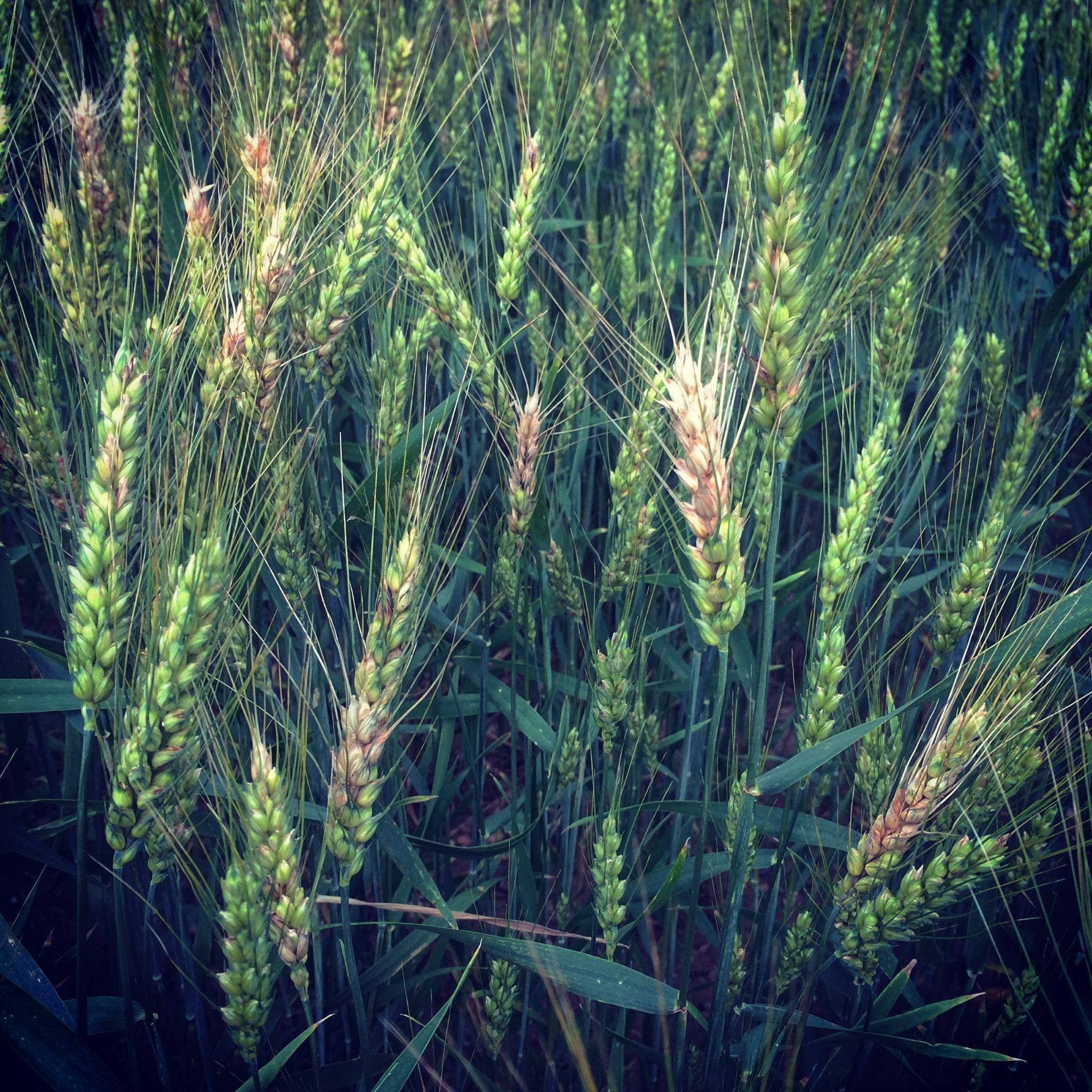
A new Section 3 MD label for Fusarium head blight (head scab) control on barley and wheat was just awarded for the Syngenta fungicide Miravis Ace, (see the label here: MIravis Ace Syngenta Label-ue1r8d).
See this article for more information on Fusarium head blight management, and stay on top of scab this year by subscribing to scabalerts and using the Fusarium Head Blight risk assessment map.

Evaluating Wheat Stands

Andrew Kness, Agriculture Agent
University of Maryland Extension, Harford County
The 2018 growing season was a record year in terms of precipitation and is one we would all like to soon forget. However, a soggy fall made it very difficult to seed the 2019 wheat crop and may have lingering effects. Persistent rains delayed planting or forced growers to plant into less-than-ideal field conditions, which may have affected seed establishment and/or plant emergence. As wheat begins to green up and as we approach planting season, it may be a good idea to consider evaluating your wheat stands to help you determine if you should keep the crop for grain vs. a cover crop, consider alternate uses, or terminate it to replant a different crop.
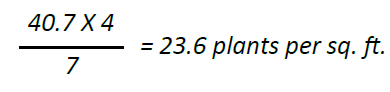
In order to accurately determine wheat stand you will need a yard stick (or any three-foot long stick) and a calculator. Place the stick along a row and count the number of plants in that three-foot section. Record this number and repeat this several times at random locations across the field that are representative of the field as a whole. I would recommend doing this at 15-20 locations to get an accurate average. Take your average and multiply it by four. Divide this number by your row width (in inches). The equation looks like this:

Example:
Plants/ 3 ft. of row: (48+41+38+36+28+51+42+39+48+43+18+29+56+49+45)/15 = 40.7
Alternatively, if your wheat is broadcast or flown on, you can calculate the number of plants per square foot by counting the number of plants in a 1 ft. x 1 ft. square or any other standardized form of measurement as long as you’re consistent (for example, you could use a hula hoop; just calculate it’s area).
To achieve maximum yield potential, stands should be at least 22 plants/sq. ft. You may want to consider alternatives for stands fewer than 12-14 plants per square foot.
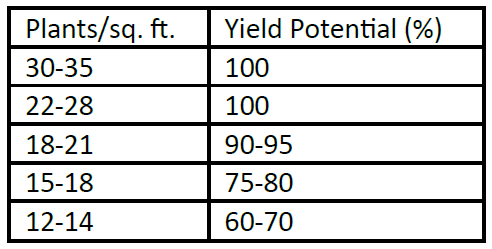
*information from the Penn State Agronomy Guide
Farmers May Apply Commercial Fertilizer to Small Grains Beginning February 15
Maryland Department of Agriculture press release
The Maryland Department of Agriculture today announced that farmers who planted small grains for harvest last fall may “top dress” these crops with commercial fertilizer beginning February 15, as long as ground conditions remain favorable and in accordance with their nutrient management plans. The determination follows Maryland’s nutrient management regulations and is based on research conducted by University of Maryland plant experts. As a reminder, manure may not be applied to fields until March 1.
Each year, University of Maryland researchers examine soil temperatures and crop growth over the winter to estimate when small grains will emerge from dormancy. According to data collected by University researchers, commercial fertilizer may be safely applied to small grains beginning February 15. At this time, these plants will have absorbed all available nutrients in the soil and will require additional nutrients to keep growing. The University cautions farmers, however, to check individual field conditions and avoid running heavy equipment across saturated soils.
The University recommends split applications of spring nitrogen with the first application occurring on or soon after February 15 and the second application when the crops begin to joint.
For additional information on Maryland’s nutrient application requirements, contact the department’s Nutrient Management Program at 410-841-5959. Farmers with fields that are not suitable for harvest should contact their crop insurance agent for guidance.
Early Aphid Occurrences: A Possible Result of Warmer Winter Temperatures
Veronica Johnson, University of Maryland Department of Entomology
Aphids are small, early season pests that can occasionally reach damaging levels in small grain fields in Maryland. Strategies to control these insects should begin with correct pest identification and field scouting to determine infestation levels within a particular field.
Pest Identification:
Aphids are soft bodied, pear-shaped insects with piercing-sucking mouthparts and a pair of “tailpipe-like” projections, or cornicles, emerging from their lower abdomen. Adults can be winged or wingless, and the vast majority of aphids are female. A number of aphid species have been documented as either direct or indirect pests of wheat in Maryland. These include the bird cherry oat aphid, english grain aphid, corn leaf aphid, and the greenbug aphid. Continue reading Early Aphid Occurrences: A Possible Result of Warmer Winter Temperatures