October 2022 Grain Market Report

Dale Johnson, Farm Management Specialist
University of Maryland

Information from USDA WASDE report
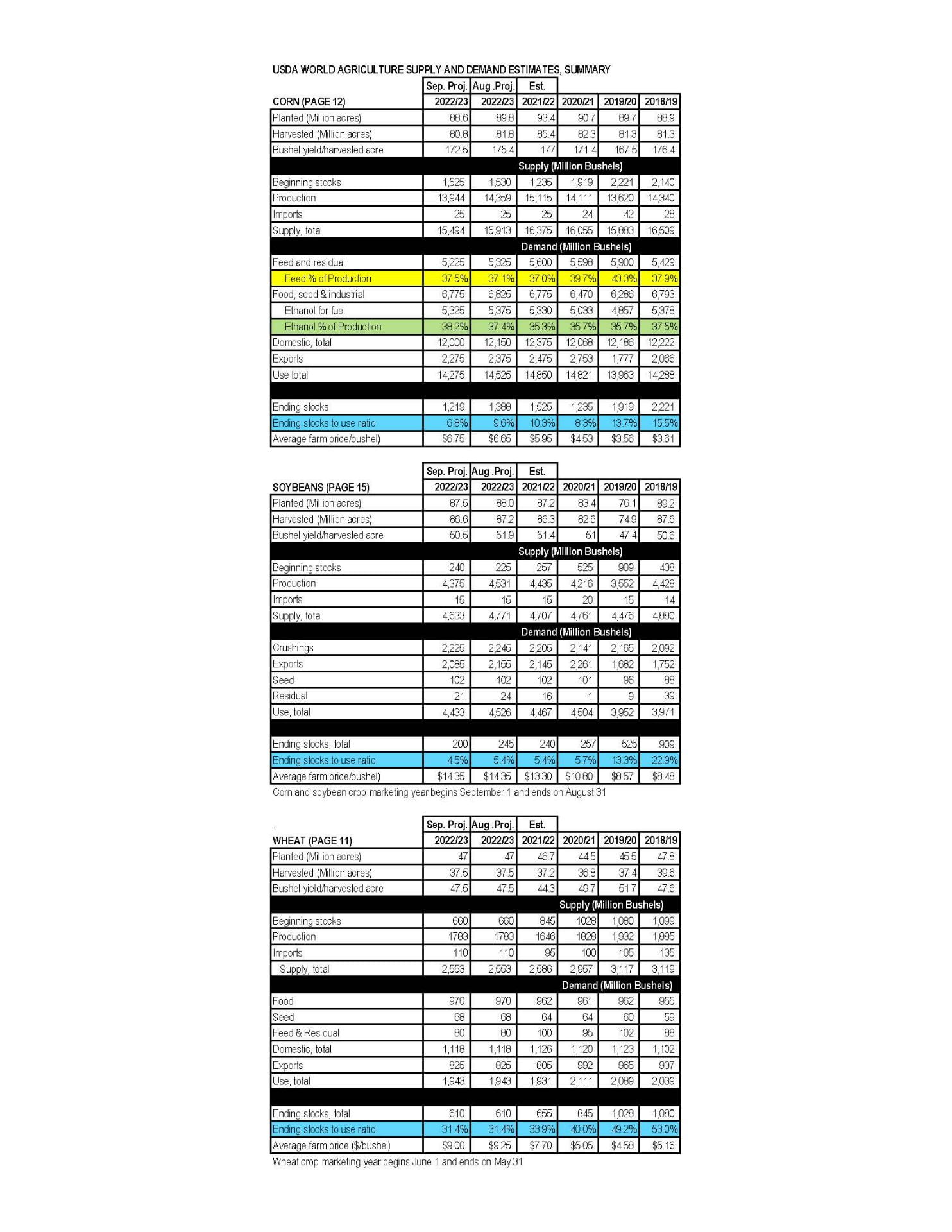
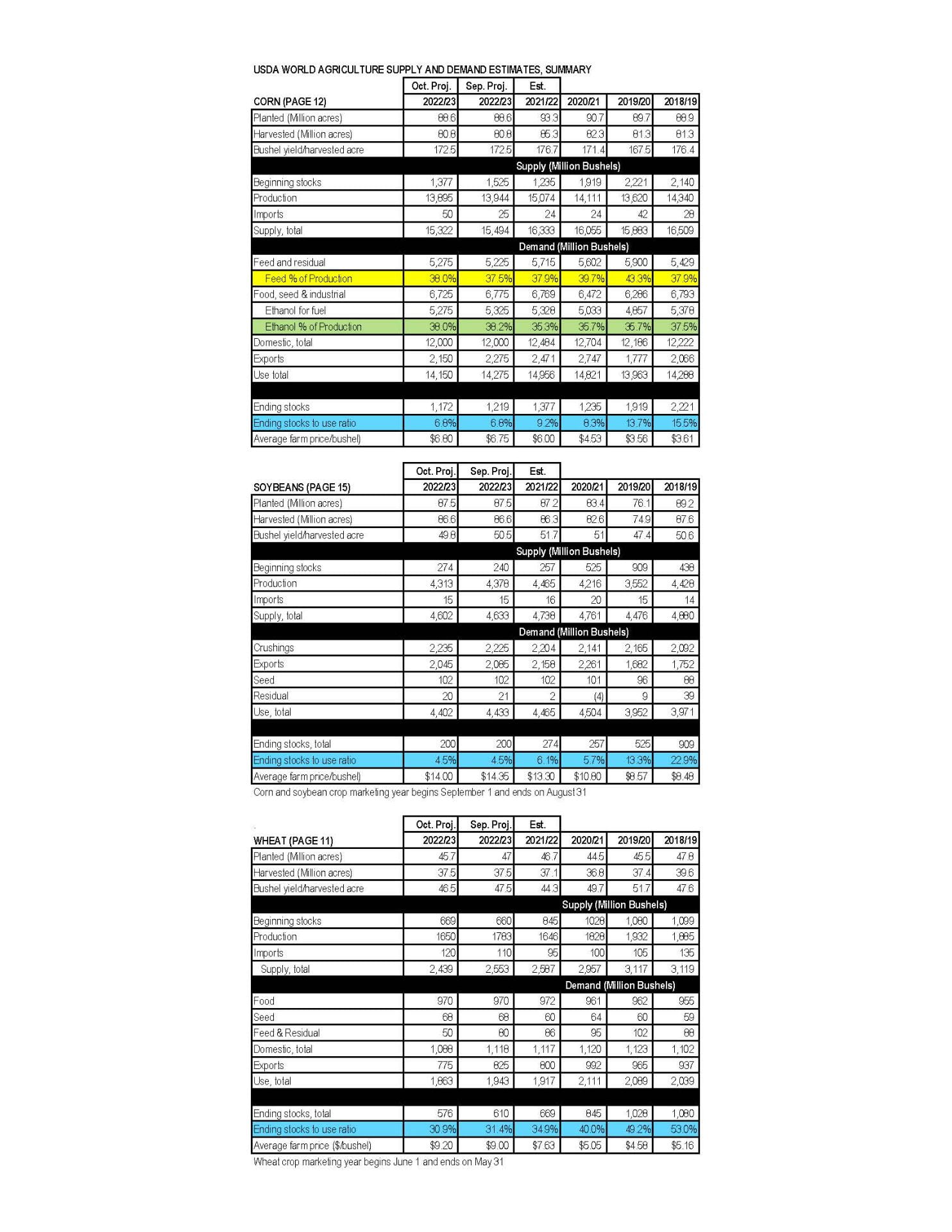
Attached is the summary for the October 2022 WASDE.


Corn

This month’s 2022/23 U.S. corn outlook is for reduced supplies, greater feed and residual use, lower exports and corn used for ethanol, and smaller ending stocks. Corn production is forecast at 13.895 billion bushels, down 49 million on a reduction in yield to 171.9 bushels per acre. Corn supplies are forecast at 15.322 billion bushels, a decline of 172 million bushels from last month, as lower production and beginning stocks are partially offset by higher imports. Exports are lowered 125 million bushels reflecting smaller supplies and slow early-season demand. Projected feed and residual use is raised 50 million bushels based on indicated disappearance during 2021/22. Corn used for ethanol is lowered 50 million bushels. With supply falling more than use, corn ending stocks for 2022/23 are cut 47 million bushels. The season-average corn price received by producers is raised 5 cents to $6.80 per bushel. 

Soybeans

Soybean production is forecast at 4.3 billion bushels, down 65 million on lower yields. Harvested area is unchanged at 86.6 million acres. The soybean yield is projected at 49.8 bushels per acre, down 0.7 bushels from the September forecast. With lower production partly offset by higher beginning stocks,
supplies are reduced 31 million bushels. Soybean exports are reduced 40 million bushels to 2.05 billion with increased competition from South America. With lower exports partly offset by increased crush, ending stocks are unchanged from last month at 200 million bushels. The U.S. season-average soybean price for 2022/23 is forecast at $14.00 per bushel, down 35 cents.

Wheat

The outlook for 2022/23 U.S. wheat this month is for lower supplies, domestic use, exports, and stocks. Supplies are reduced on lower 2022/23 production based on the NASS Small Grains Summary that indicated reductions in both harvested area and yield. This lowered production by 133 million bushels to 1,650 million, leaving production only minimally higher than last year. Partially offsetting the production decline are higher projected imports, raised 10 million bushels to 120 million, all for Hard Red Spring. Annual feed and residual use is lowered 30 million bushels to 50 million, based on first quarter disappearance, as indicated in the NASS Grain Stocks report. This is the lowest first quarter total disappearance since 1983/84. Wheat exports are lowered 50 million bushels to 775 million on reduced supplies, slow pace of export sales, and continued uncompetitive U.S. export prices. This would be the lowest U.S. wheat exports since 1971/72. Projected ending stocks are lowered 34 million bushels to 576 million, which would be the lowest since 2007/08. The season-average farm price is raised $0.20 per bushel to $9.20 on reported NASS prices to date and expectations for futures and cash prices for the remainder of 2022/23.
September 2022 Grain Market Summary

Dale Johnson, Farm Management Specialist
University of Maryland

Information from USDA WASDE report
Attached is the summary for the September 2022 WASDE.


Corn

This month’s 2022/23 U.S. corn outlook is for lower supplies, smaller feed and residual use, reduced exports and corn used for ethanol, and tighter ending stocks. Projected beginning stocks for 2022/23 are 5 million bushels lower based on essentially offsetting export and corn used for ethanol changes for 2021/22. Corn production for 2022/23 is forecast at 13.9 billion bushels, down 415 million from last month on reductions to harvested area and yield. The national average yield is forecast at 172.5 bushels per acre, down 2.9 bushels. Harvested area for grain is forecast at 80.8 million acres, down 1.0 million. Total U.S. corn use is cut 250 million bushels to 14.3 billion. Feed and residual use is lowered 100 million bushels based on a smaller crop and higher expected prices. Exports are cut 100 million bushels to 2.3 billion while corn used for ethanol is lowered 50 million to 5.3 billion. With supply falling more than use, ending stocks are down 169 million bushels to 1.2 billion. The season-average corn price received by producers is raised 10 cents to $6.75 per bushel.

Soybeans

U.S. soybean supply and use changes for 2022/23 include higher beginning stocks and lower production, crush, exports, and ending stocks. Higher beginning stocks reflect a lower export forecast for 2021/22. Soybean production is projected at 4.4 billion bushels, down 152 million with lower harvested area and yield. Harvested area is down 0.6 million from the August forecast. The soybean yield forecast of 50.5 bushels per acre is down 1.4 bushels from last month. The crush forecast is reduced 20 million bushels and the soybean export forecast is reduced 70 million bushels on lower supplies. Ending stocks are projected at 200 million bushels, down 45 million from last month. The U.S. season-average soybean price is forecast at $14.35 per bushel, unchanged from last month. Soybean meal and oil prices are also unchanged at $390 per short ton and 69.0 cents per pound, respectively. Other changes this month include lower peanut and higher cottonseed production.

Wheat

The 2022/23 U.S. wheat outlook for supply and use is unchanged this month. The projected 2022/23 season-average farm price (SAFP) is lowered $0.25 per bushel to $9.00 on reported NASS prices to date and expectations for cash and futures prices the remainder of 2022/23. Despite the decline, $9.00 per bushel would remain a record SAFP.

June 2022 Grain Market Summary

Dale Johnson, Farm Management Specialist
University of Maryland

Information from USDA WASDE report

Attached is the summary for the June 2022 WASDE.

Corn

This month’s 2022/23 U.S. corn outlook is for larger beginning stocks, slightly higher use, and increased ending stocks. Corn area and yield forecasts are unchanged. USDA will release its acreage report on June 30, which will provide survey based indications of planted and harvested area. Beginning stocks are up 45 million bushels mostly reflecting a forecast decline in exports for 2021/22. Exports are lowered 50 million bushels, based on reported U.S. Census Bureau shipments through the month of April and export inspection data for the month of May. Food, seed, and industrial use (FSI) is raised 5 million bushels as projected increases in the amount of corn used for glucose and dextrose and starch is partially offset by a decline in high fructose corn syrup. These FSI use changes are carried through for 2022/23. With no other 2022/23 use changes, ending stocks are raised 40 million bushels. The season-average farm price received by producers is unchanged at $6.75 per bushel.

Soybeans

This month’s U.S. soybean supply and use projections for 2022/23 include lower beginning and ending stocks and higher prices. Lower beginning stocks reflects increased exports for 2021/22. Soybean exports for 2021/22 are raised 30 million bushels to 2.17 billion reflecting strong export sales and a reduced export forecast for Brazil. With reduced supplies for 2022/23 and no use changes, soybean ending stocks are projected at 280 million bushels, down 30 million. The soybean price is forecast at $14.70 per bushel, up 30 cents from last month.

Wheat

The outlook for 2022/23 U.S. wheat this month is for increased supplies, unchanged domestic use and exports, and higher stocks. Supplies are raised on higher production with all wheat production projected at 1,737 million bushels, up 8 million from last month. NASS raised winter wheat production to 1,182 million bushels as increases for Soft Red Winter and White Winter more than offset a reduction for Hard Red Winter. The all wheat yield is 46.9 bushels per acre, up 0.3 bushels from last month. Projected 2022/23 ending stocks are raised 8 million bushels to 627 million, still down 4 percent from 2021/22. The projected 2022/23 season-average farm price is unchanged at $10.75 per bushel, compared to $7.70 for 2021/22.

June Insect Scouting Tips

Emily Zobel, Senior Agriculture Agent Associate | ezobel@umd.edu
University of Maryland Extension, Dorchester County

Be sure to check all labels carefully before combining insecticides and herbicides. Thresholds are based on sampling 100 plants (10 plants x 10 locations).

Alfalfa

Begin scouting for potato leafhoppers (PLH). Stubble insecticide applications are rarely needed and seldom provide reasonable control since adult leafhoppers will move out of the field after cutting. A rough threshold estimate is 20 PLH per 100 sweeps on alfalfa 3 inches or less in height, 50 PLH per 100 sweeps in 4-6 inch tall alfalfa, and 100 PLH per 100 sweeps in 7-11 inch tall alfalfa. A more precise threshold chart can be found on Penn State Extension website https://extension.psu.edu/potato-leafhopper-on-alfalfa.

Field Corn

Scout for armyworms and cutworm if growing a hybrid that doesn’t control for them. Treatment threshold for armyworms in corn is 25% infested plants with larvae less than one inch long. Large larvae feeding deep in the whorls will be challenging to control. When scouting for cutworm, check/dig around the base of the plants to determine if cutworms are present and alive. Cutworms tend to be more common in late terminated cover crop, late planted corn fields. Cutworm thresholds are 5% cut plants at V2-V4 or 10% of plants with signs of fresh leaf feeding.

Once plants start to silk, scout for Japanese beetles and stink bugs. For Japanese beetles, the treatment threshold is when there is less than ½ inch of silk and less than 50% pollination, and an average of 2 or more beetles per ear. For stink bugs, the threshold is 1 bug per 10 plants (V1 to V6), 1 bug per 8 plants (V14 to VT), and 1 bug per 4 plants (R1 to R2). Cereal leaf beetle, stink bugs, and Japanese beetles are ‘edge’ pests, so treatment may only be needed around field edges and pivot tracks.

May 2022 Grain Market Report

Dale Johnson, Farm Management Specialist
University of Maryland

Information from USDA WASDE report

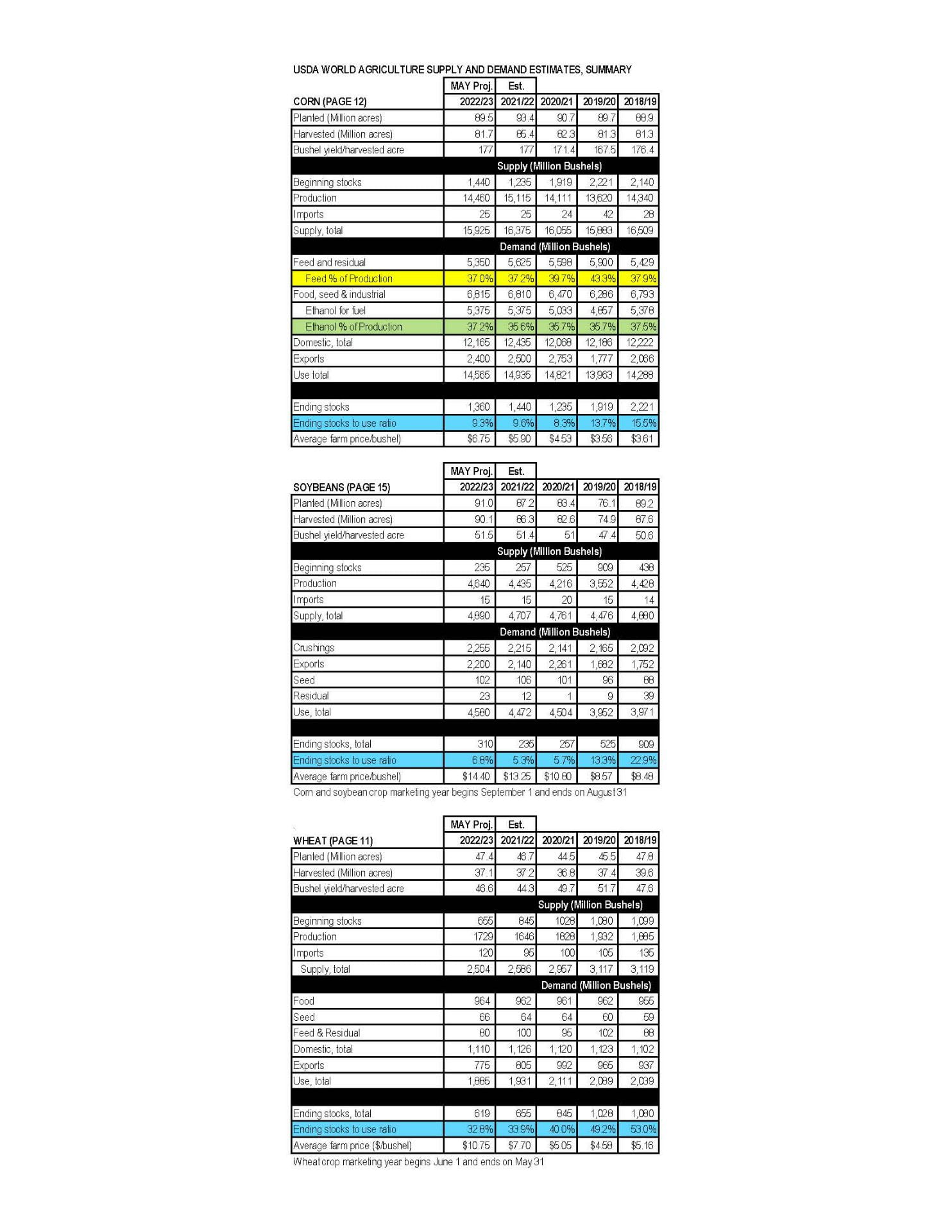
Attached is the summary for the May 2022 WASDE.

Corn

The 2022/23 U.S. corn outlook is for lower production, domestic use, exports, ending stocks, and higher prices. The corn crop is projected at 14.5 billion bushels, down 4.3 percent from last year. The corn yield is projected at 177.0 bushels per acre, 4.0 bushels below the weather adjusted trend presented at USDA’s Agricultural Outlook Forum in February. The very slow start to this year’s planting in the major corn producing States and the likelihood that progress by mid-May will remain well behind normal reduce yield prospects. Despite beginning stocks that are up relative to a year ago, total corn supplies are forecast to decline 2.7 percent to 15.9 billion bushels. Total U.S. corn use in 2022/23 is forecast to fall 2.5 percent on declines in domestic use and exports. Food, seed, and industrial (FSI) use is virtually unchanged at 6.8 billion bushels. Corn used for ethanol is unchanged relative to a year ago on expectations of flat U.S. motor gasoline consumption. Corn feed and residual use is down 4.9 percent relative to a year ago, reflecting a smaller crop, higher expected season-average farm prices received by producers, and a decline in grain consuming animal units. U.S. corn exports are forecast to decline 4.0 percent in 2022/23 as lower supplies and robust domestic demand limit prospects. Even with record exports projected for Argentina and Brazil, a 550-million-bushel drop in exports for Ukraine due to the ongoing conflict is the primary catalyst for a decline in world trade. With expectations of robust global demand in the face of high prices, the U.S. share of global corn trade is up slightly relative to a year ago. With total U.S. corn supply falling more than use, 2022/23 U.S. ending stocks are down 80 million bushels from last year. Stocks relative to use at 9.3 percent would be below a year ago and lower than the 14.4 percent average seen during 2015/16 to 2019/20. The season-average corn price received by producers is projected at $6.75 per bushel, up 85 cents from a year ago and if realized the highest since $6.89 reached during 2012/13.

Soybeans

The 2022/23 outlook for U.S. soybeans is for higher supplies, crush, exports, and ending stocks compared with 2021/22. The soybean crop is projected at 4.64 billion bushels, up 5 percent from last year’s crop mainly on higher harvested area. With slightly lower beginning stocks, soybean supplies are projected at 4.89 billion bushels, up 4 percent from 2021/22. The U.S. soybean crush for 2022/23 is projected at 2.26 billion bushels, up 40 million from the 2021/22 forecast. Domestic soybean meal disappearance is forecast to increase 2 percent from 2021/22 with low soybean meal prices relative to corn. U.S. soybean meal exports are forecast at 14.4 million short tons, leaving the U.S share of global trade near the prior 5-year average. With increased supplies, U.S. soybean exports are forecast at 2.2 billion bushels, up 60 million from the revised 2021/22 projection. Despite reduced soybean supplies available for export from South America for the first half of the 2022/23 marketing year, an anticipated record harvest and sharply higher exports beginning in early 2023 is expected to leave the U.S. with a lower share of global trade in 2022/23. U.S. ending stocks for 2022/23 are projected at 310 million bushels, up 75 million from the revised 2021/22 forecast. The 2022/23 U.S. season-average soybean price is forecast at $14.40 per bushel compared with $13.25 per bushel in 2021/22. Soybean meal prices are forecast down $20 per short ton from 2021/22 to $400 per short ton and soybean oil prices are forecast down 5 cents to average 70 cents per pound, as oilseed and product supplies rebound in foreign markets.

Wheat

The outlook for 2022/23 U.S. wheat is for reduced supplies, exports, domestic use stocks, and higher prices. U.S. 2022/23 wheat supplies are projected down 3 percent, as lower beginning stocks more than offset a larger harvest. All wheat production for 2022/23 is projected at 1,729 million bushels, up 83 million from last year, as higher yields more than offset a slight decrease in harvested area. The all wheat yield, projected at 46.6 bushels per acre, is up 2.3 bushels from last year. The first survey-based forecast for 2022/23 winter wheat production is down 8 percent from last year as lower Hard Red Winter and Soft Red Winter production more than offset an increase in White Wheat production. Abandonment for Winter Wheat is the highest since 2002 with the highest levels in Texas and Oklahoma. Spring Wheat production for 2022/23 is projected to rebound significantly from last year’s drought-reduced Hard Red Spring and Durum crops primarily on return-to-trend yields. Total 2022/23 domestic use is projected down 1 percent on lower feed and residual use more than offsetting higher food use. Exports are projected at 775 million bushels, down from revised 2021/22 exports and would be the lowest since 1971/72. Projected 2022/23 ending stocks are 6 percent lower than last year at 619 million bushels, the lowest level in nine years. The projected 2022/23 season-average farm price (SAFP) is a record $10.75 per bushel, up $3.05 from last year’s revised SAFP. Wheat cash and futures prices are expected to remain sharply elevated through the first part of the marketing year when the largest proportion of U.S. wheat is marketed.

Maryland Regional Crop Reports: May 2022

Western Maryland

Erratic weather patterns continue to dominate and challenge us here in Washington County. While we can still use precipitation, it has recently been coupled with wild temperature swings. In the 70s or low 80s and then back to the low fifties with nighttime temperatures on several occasions hovering near freezing. Triticale harvest is over half finished but very little corn has gone in the ground. First cutting alfalfa will begin early next week barring rain showers. First cutting hay of any kind looks like it will be below normal. Forever the optimist, second cutting will be better.—Jeff Semler, Washington Co.

Central Maryland

Small grain silage harvest is in full swing. Manure is being hauled and corn is being planted. Some soybeans have been planted. First cutting of hay may also start soon. Over the past month, most of the area has been at or above normal rainfall, according to the National Weather Service. Field work may slow down depending on much rain we get this weekend, but next week is forecasted to be drier and in the 70s. —Kelly Nichols, Montgomery Co.

Northern Maryland

The trend for April has been a continuation of March—cool temperatures that rarely want to move out of the 60s. As a result, the start of planting was about a 5-10 days later than usual for this region. Most planting kicked off the week of Easter. In general, small grains look good. Barley is headed out and wheat is a couple of weeks away. Some rye has been chopped for feed. Pastures and hay fields are enjoying the cooler temperatures.—Andy Kness, Harford Co.

Upper & Mid Shore

Soil moisture has been perfect for spring crops, field work, and planting. Soil temperatures have been a little cool for this time of year. Many acres of corn and beans have went in over the past week. Barley is fully headed and wheat will be in a few days. Both look good. Hay and pastures look good, but the cool weather has them a little behind normal.—Jim Lewis, Caroline Co.

Lower Eastern Shore

Wheat is starting to pollinate. It’s been a relatively dry spring, making for an average to above average wheat crop, with minimal disease pressure. Cover crops have been mostly terminated. However, where still standing, cover crops are looking great. These late-terminated cover crops should bring additional benefits to the fields, such as providing substantial organic matter to the soil, and in some cases releasing nitrogen on the soil surface. Growers have spread poultry manure. Weather has been relatively favorable these last couple of weeks for planting. Corn has started to be planted. Much more corn acreage is expected to be planted in the next weeks, to be followed by soybean planting.—Sarah Hirsh, Somerset Co.

Southern Maryland

The region has experienced good planting conditions over the last week. Corn planting progress is still a bit behind schedule with cooler soils limiting the number of early-planted acres. Most farmers are finishing up with corn planting and have started with soybean planting. Recent showers were welcome with soil conditions becoming slightly dry during the last couple of weeks. Wheat is in the early heading stage and many fields will be flowering by the time you read this. Farmers will be evaluating the need for a head scab fungicide in the next few days. Many wheat fields are exhibiting yellowing in the upper canopy that is not readily attributable to any disease. We are also seeing a lot of powdery mildew in the lower canopy, but very little in the upper canopy. Insect and disease pressure has been light so far. Forage crops look great this spring. Alfalfa weevil are very active this year and many fields required treatment. Pyrethroid resistance continues to be an issue for our growers. First cutting of cool season grasses is underway.—Ben Beale, St. Mary’s Co.

*Regions (counties):

Western: Garrett, Allegany, Washington. Central: Frederick, Montgomery, Howard. Northern: Harford, Baltimore, Carroll. Upper & Mid Shore: Cecil, Kent, Caroline, Queen Anne, Talbot. Lower Shore: Dorchester, Somerset, Wicomico. Southern: St. Mary’s, Anne Arrundel, Charles, Calvert, Prince George’s

2022 Corn, Soybean, and Wheat Fungicide Efficacy Tables

Andrew Kness, Agriculture Agent | akness@umd.edu
University of Maryland Extension, Harford County

Each year, data from Universities around the country are aggregated and used to update fungicide efficacy guides for corn, soybean, and wheat. These tables are put together by the Crop Protection Network and can be found on cropprotectionnetwork.org.

These tables serve as handy reference guides to determine the best chemistry to manage certain diseases. The ratings in the table reflect the relative efficacy of a product to manage a given disease, it does not rate yield response to a fungicide. Links to the tables are found below, or contact your Extension agent for a copy.

Soybean seedling diseases

Soybean foliar diseases

Corn foliar diseases

Wheat foliar diseases

April 2022 Grain Market Report

Dale Johnson, Farm Management Specialist
University of Maryland

Information from USDA WASDE report

Attached is the summary for the April 2022 WASDE.

Corn

There were no changes on the corn supply side from the March 9 WASDE estimates. On the demand side, there were minor changes but total use and Ending stocks remained the same. Ending stocks are estimated to be 1,440 million bushel, with a stocks-to-use ratio of 9.6%. December 2022 Corn futures remain in a bullish volatile market with prices increasing from $6.37 on March 9 to a high of $7.18 on April 8 as extraordinary world events drive market prices up. A lower than expected prospective plantings report on March 31 pegged planting at 89.5 million contributed to higher prices for the 2022 crop year.

Soybean

There were no changes on the soybean supply side from the March 9 WASDE estimates. On the demand side, export estimates were increased by 25 million bushel, seed was increased by 4 million bushel and the residual estimate was decreased by 3 million bushel. This resulted in a lower estimate of ending stocks at 260 million bushel and a decrease in the stocks-to-use ratio from 6.4% to 5.8%. November 2022 futures prices have been volatile the past month. A higher than expected prospective plantings report on March 31 pegged planting at 91 million contributed to a price dip but has since recovered to a high of $14.98 on April 8.

Wheat

On the supply side, import estimates were decreased by 5 million bushel. On the demand side, Feed & Residual was decreased 10 million bushel. Export estimate was decrease by 25 million bushel. These changes increased the ending stocks by 30 million bushel to 678 million bushel and the stocks to use ratio increased from 33.4% to 35.5%. On March 3 & 7, the market was limit up as trading was halted on those days. The market then went limit down on March 8, 9 , & 10. On March 9 &10 there was no trading. The market has declined since then from the $12.50 range to a high of $10.60 on April 8.

Field Crop Budgets for 2022

Shannon Dill, Principal Agriculture Agent
University of Maryland Extension, Talbot County

The University of Maryland Extension has updated www.go.umd.edu/grainmarketing site with new input data and spray programs for the 2022 field crop budgets.

Crop Budgets

Cost of production is very important when making decisions related to your farm enterprise and grain marketing. Enterprise budgets provide valuable information regarding individual enterprises on the farm. This tool enables farm managers to make decisions regarding enterprises and plan for the coming production year. An enterprise budget uses farm revenue, variable cost, fixed cost and net income to provide a clear picture of the financial health of each farm enterprise.

The 2022 Maryland enterprise budgets were developed using average yields and estimated input cost based upon producer and farm supplier data. There has been a lot of fluctuation in fertilizer prices, pesticide availability and fuel expenses. The figures presented are averages and vary greatly from one farm and region to the other. Therefore, it is crucial to input actual farm data when completing enterprise budgets for your farm.

How to Use University Enterprise Budgets

Enterprise budgets can be used as a baseline for your operation. Make changes to these budgets to include your production techniques, inputs and overall management. New spray programs were added for herbicide resistant weeds.

The budgets are available electronically in PDF or Excel. Use this document as a start or reference to create your crop budgets. If you have problems downloading any of these budgets, contact information is located on the website.

Average Cost Per Acre, 2022 
Year Corn

No Till

Corn

Conventional

Full Season

Soybeans

Wheat Double Crop

Wheat/Beans

2021 $540 $592 $346 $401 $608
2022 $698 $749 $402 $490 $749
Percent Change +29% +26% +16% +22% +23%

March 2022 Grain Market Report

Dale Johnson, Farm Management Specialist
University of Maryland

Information from USDA WASDE report

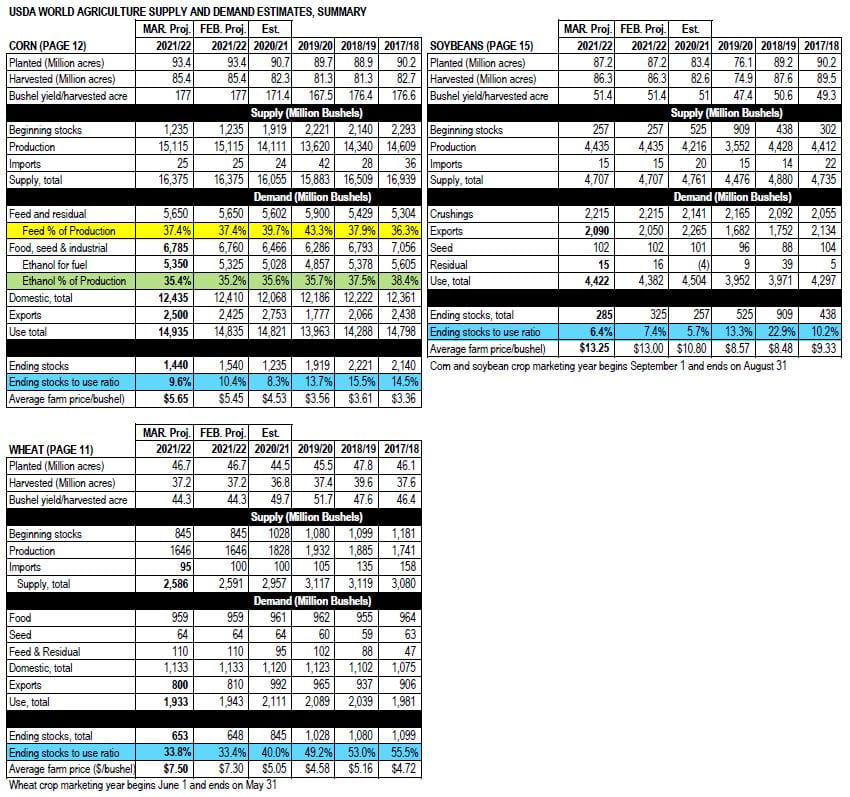
Attached is the summary for the March 2022 WASDE.

Corn

There were no changes on the corn supply side from the February 9 WASDE estimates. On the demand side, ethanol estimates increased 25 million bushel and esports increased 75 million bushel for a total demand increase of 100 million bushel. Ending stocks are estimated to be 1,440 million bushel, decreasing the stocks-to-use ratio from 10.4% in February to 9.6% in March. March 2022 Corn futures increased from $6.47 on February 9 to peak at $8.00 on March 4 and settle back to $7.45 March 9 as extraordinary world events drive market prices up.

Soybeans

There were no changes on the soybean supply side from the February 9 WASDE estimates. On the demand side, export estimates were increased by 40 million bushel and the residual estimate was decreased by 1 million bushel. This resulted in a lower estimate of ending stocks at 285 million bushel and a decrease in the stocks-to-use ratio from 7.4% to 6.4%. March 2022 futures price increased dramatically from $15.95 on February 9 to peak at $17.65 on February 24 and settle back to $16.87 on February 9 as extraordinary world events drive market prices up.

Wheat

On the supply side, import estimates were decreased by 5 million bushel. On the demand side, export estimates were decreased 10 million bushel. These changes increased the ending stocks by 5 million bushel to 653 million bushel and the stocks to use ratio increased from 33.4% to 33.8%. However, extraordinary world events drove March futures from $7.85 on February 9 to peak at 14.25 on March 7. On March 3 & 7, the market was limit up as trading was halted on those days. The market then went limit down on March 8, 9 , & 10. On March 9 &10 there was no trading. The market went limit down at the opening. On March 11 the market closed at $10.90 after the wildest ride in history.