Thoughts on Tar Spot Management

Andrew Kness, Senior Agriculture Agent | akness@umd.edu
University of Maryland Extension, Harford County

Tar spot is on the mind of many farmers as we enter the 2024 growing season and I have had many conversations with farmers and consultants about strategies for managing this disease. Here are some things to consider and keep in mind as we get into the peak of the corn growing season.

Tar spot is a disease of corn caused by the fungus Phyllachora maydis. This disease was first reported in limited amounts in Harford and Cecil County in 2022; in 2023 the disease spread to at least 8 counties in Maryland and by harvest ‘23, we found tar spot at a frequency of over 50% of fields scouted here in Harford County.

The tar spot disease cycle starts with old corn crop residue where the fungal spores lay dormant over winter. As conditions become optimal for its development in late spring/summer, spores are released and blown and/or splashed onto corn plants where the spore will germinate and infect the plant. Approximately 12-15 days after infection, symptoms will develop on the corn leaves and/or husks, which include dark, raised, lesions, which are the reproductive structures called stromata (Fig. 1). Inside the stromata are spores (Fig. 2), which are released and will infect new tissue. Tar spot is a polycyclic disease, meaning it has multiple generations or cycles per year. New infections will occur throughout the growing season for as long as green, living corn tissue is present and environmental conditions are favorable.

Figure 1. Tar spot stromata (raised black specks) on corn leaf.
Figure 2. Microscope image of P. maydis ascus containing ascospores, which are blown and splashed to infect new corn tissue. Image: A. Kness, UMD.

Here in Maryland and the Mid-Atlantic, tar spot has not been reported to cause any significant epidemics or yield losses thus far, mostly because it becomes established late in the growing season; but that is not to say that serious epidemics couldn’t happen. In the Midwest, tar spot has been reported to cause upwards of 50 bushel per acre yield loss, and it was ranked the #1 yield-limiting disease for corn in the U.S. in 2021, 2022, and 2023.

Since tar spot was first confirmed in the United States in 2015, we have learned a lot about its epidemiology. Tar spot hails from the cooler mountain areas of Latin America. When tar spot first moved into the U.S., we had initially thought that mild temperatures and moisture were key variables in the development of the disease; however, recent research has found that moisture plays a role, but temperature is far more crucial. Webster et. al. (2023) found that monthly temperature average between 64-73°F were optimal for tar spot development and temperatures exceeding 73°F significantly reduced tar spot progression. What was more interesting is that they found that moisture both promoted and inhibited tar spot disease progression. Moisture early in the disease cycle aids in infection, but prolonged moisture (greater than 90% humidity) actually inhibits disease progression. Tar spot develops when relative humidity is less than 90% for a 2-3 week period, coupled with mild temperatures. This makes sense for many that may have observed tar spot in 2023, which was not a particularly wet year.

With this in mind, we should consider how these weather parameters influence our management of this disease here in Maryland where our summers tend to be hotter and more humid than many areas of the corn belt states.

If you look at the 5-year average monthly temperatures from regional weather stations (Table 1), you can see that the months of July and August for Mid-Atlantic regions are well outside of the 64-73°F window for optimum tar spot development. Compare that with data from Iowa for example, and they consistently run within or very close to the optimal temperature range. While only a few degrees may not seem like much, I believe our hot summers may actually keep tar spot at bay until later in August and September on an average year, which would be consistent with when we have found tar spot in Maryland in 2022 and ‘23. If these trends hold true, the majority of our corn crop is well into later grain fill stages by the time milder temperatures arrive, effectively avoiding tar spot development during the most crucial growth stages. In contrast, 30-day average temperatures are within or near the 64-73°F optimum range during corn’s most vulnerable growth stages in the corn belt.

Table 1. Average Monthly Temperatures (°F), 2019-2023
  Westminster, MD Salisbury, MD Arlington, VA Waterloo, IA
May 63.46 64.08 66.13 60.70
June 72.48 72.95 75.53 72.90
July 79.54 77.99 80.96 75.52
August 77.22 76.25 78.77 72.00
September 69.94 69.99 72.60 66.20

Where tar spot could become problematic here are instances where we have an unusually cool June and July which would put the majority of our corn at risk of tar spot infection during it’s most vulnerable time, which is tasseling through early to mid grain full.

Another situation where tar spot could be a problem is for late planted and late maturing hybrids that are in reproductive phases in August and September. Fields that are corn after corn are also in a higher risk situation.

For 2024, I would highly recommend scouting and paying close attention to the weather conditions just prior to tasseling through grain fill in your corn fields. There is an app that can help you determine your tar spot risk, called Tarspotter, and has been reported to be 90% accurate. The app takes into consideration regional weather data and field management to determine a risk percentage. It’s available for download for free on iPhone and Android.

If you decide to treat your corn with a fungicide to manage tar spot, VT/R1 timing is still found to be the most effective and economical. A fungicide application at this time will also effectively manage other common foliar fungal diseases of corn (which we shouldn’t forget about), such as grey leaf spot and northern corn leaf blight. Most fungicides labeled for tar spot are effective, however there is a better response to products that have 2 and 3-way modes of action.

This year we will continue to conduct research on tar spot in Maryland with funds from the Maryland Grain Producers Utilization Board. If you find tar spot this year, please report your findings to me via email (akness@umd.edu) or phone (410-638-3255) or on corn.ipmpipe.org.

Maryland Regional Crop Reports: May 2024

Reports are for crop conditions up to May 3, 2024.

Western Maryland

April has brought us many showers. The triticale is all in the silos for the most part, and corn planting has begun. The wheat and the barley are looking good. Producers have a keen eye out for FHB, and thus, fungicide is on the docket. Pastures are looking good and first cutting alfalfa is not far off. Warmer temperatures are on the horizon.—Jeff Semler, Washington Co.

Central Maryland 

The wet, cool spring has turned into a hot, dry spring this week. Currently, the highest chance of rain (about 60%) is for this weekend. Planting is in full swing, and the first cutting of orchardgrass will start in a couple weeks. Wheat and barley are heading; if the drier weather keeps up, it will lower the risk for Fusarium.—Kelly Nichols, Montgomery Co.

Northern Maryland

Rain has been hard to come by with only about 1” of accumulated rain in the last 4 weeks. Corn and soybean planting has been in rolling for 2.5 weeks now, with a very large majority of it within the last week to 10 days or so. Small grains generally look very good, pastures and hay fields have also enjoyed the cooler than normal March and April. Wheat is anywhere from boot to head emergence. After a soggy start to April, we could use some rain.—Andy Kness, Harford Co.

Upper and Mid Shore

The rains from early in the month are now just a memory, with clear skies and no significant rainfall since. Dust clouds swirling on the horizon are a clear sign that #Plant2024 is underway. Farmers are terminating their cover crops and tilling the soil, readying it for planting. This year, we’re running a week or two ahead of last year’s schedule, raising hopes for another bumper crop. Small grains are currently heading, with some currently flowering.—Dwayne Joseph, Kent Co.

Lower Shore

After a rainy stretch, we’ve gotten some dry weather this past week. About half or more of cover crop acreage has been terminated. Some ground is being tilled, while the majority will be planted no-till. Corn is currently being planted. Wheat is looking very good. If wheat varieties are susceptible to Fusarium Head Blight and if the wheat is flowering, fungicides should be considered. The first cutting of hay has started.—Sarah Hirsh, Somerset Co.

Southern Maryland

Field conditions are a mixed bag. Areas to the north have turned dry in the last week. Areas to the south received more rain delaying field operations. In drier areas, soil has become hard and compacted, aggravated by wet conditions over the winter. This is a year where big differences in soil conditions can be observed between no-till and tilled fields. Planters have been rolling for the last two weeks with conditions mostly ideal for planting. Corn emergence looks good so far. Slugs were a concern early, but drier weather has helped with that issue. We have many acres of early planted soybeans again this year. Burndown programs have been challenged this year with many escapes of annual ryegrass. Wheat is headed and beginning to flower now. We are observing some yellowing of the flag leaf and leaf below the flag leaf across many fields that showed up in the last 10 days. We are working to determine the exact cause, but believe it related to environmental conditions with perhaps some virus issues like BYDV as well. A lot of good dry hay has been made in the last two weeks. On the fruit and vegetable front, plasticulture strawberries look very good and are ripening now. All of our main season vegetable crops are preparing to go in the ground this week. High tunnel crops are coming off now.—Ben Beale, St. Mary’s Co.

*Regions (counties):
Western: Garrett, Allegany, Washington. Central: Frederick, Montgomery, Howard. Northern: Harford, Baltimore, Carroll. Upper & Mid Shore: Cecil, Kent, Caroline, Queen Anne, Talbot. Lower Shore: Dorchester, Somerset, Wicomico. Southern: St. Mary’s, Anne Arundel, Charles, Calvert, Prince George’s

Biological Products: To Use or Not To Use (and how to systematically answer this question)

Nicole Fiorellino, Extension Agronomist | nfiorell@umd.edu
University of Maryland, College Park

Have you thought about how you might incorporate newly-available biological products into your operation? Maybe you are interested, but skeptical about the return on investment? I will briefly define “biologicals” then provide my thoughts on how to navigate the old adage, “to use or not to use.” I operationally define biological products as commercially-available amendments that are adding a living organism to your growing system, either to the soil or directly to the plant. Generally, these products are meant to replace a fertilizer application by unlocking nutrients stored in the soil or amplifying natural processes that harness nutrients, namely nitrogen (N), from the atmosphere. While a variety of products from different brands can be broadly categorized as biologicals, it is important to take the time to understand the specific “mode of action” of individual biological products and compare that to your field conditions as a first step towards deciding if you will use a product.

Most biological N products aim to increase the mineralization of organic N stored in your soil to inorganic forms that are plant available. The mineralization step of the N cycle is mediated by microorganisms that spend energy to digest organic N and transform it to inorganic, plant-available N. When there is ample inorganic N present in the soil, like after a fertilizer application, for example, the microorganisms are “signaled” that ample N is present and they conserve energy by slowing down, or even stopping, mineralizing organic N. So biological products aim to “block” the signal to microorganisms that instructs them to cut off mineralization and they signal microorganisms to increase the organic N that is mineralized; hence adding more N to the soil with additional fertilizer application.

The increased availability of the soil storage of organic N or the provision of N to plants without fertilizer is accomplished through the introduction of novel N-fixing bacteria that allow a cereal crop, like corn, to fix N like a legume; by providing a stimulant to native soil bacteria to kick-start mineralization; or by infecting the corn plant with an N-fixing bacteria that fixes N from the atmosphere with no additional available N present in the soil – each of these examples represents the mode of action of a different biological product. While it seems like these products have the potential to supply nearly unlimited amounts of N to your crops, they should be viewed as fertilizer replacements, not necessarily as bonus N on top of your current fertility plan. Moreover, despite some marketing claims that yield benefits would be observed across all acres of a farm, a farmer might be more likely to observe a yield response where fertility is low, maybe on marginal acres where fertilizer applications or field operations are delayed due to logistics and timing. Finally, beyond the cost per acre of the product itself, you may want to consider the ease of use of the product and the cost in time associated with product use, including restrictions on tank mixing, application timing, and extra trips across the field.

Once your head is spinning from those considerations and you think you may want to try a new product, your next step may be to see out local research data on a product’s efficacy or maybe even check with your neighbor to learn about their experience with the product. The specific nature of the individual biological products and their interaction with soil nutrient concentration means that University data or even data from your neighbor may not represent the results you might expect on your farm. Unlike the universally-expected yield response with increased fertilizer application across the spectrum of soil and environmental conditions, the potential yield response to the use of biological products varies greatly with location, soil type, and weather conditions – meaning in the same location across multiple years, there may be a different response to the use of these products.

We recommend performing trials on your farm to aid your decision to use biological products. A first step to determine a yield response will be to understand how efficiently you are using N fertilizer on your field. This can be accomplished with a simple field-length strip plot protocol using multiple N fertilizer rates and up to two biological products of your choice. The Agronomy Program at University of Maryland has launched an On-Farm Trials program, with funding support from the Maryland Grain Producers Utilization Board. We encourage farmers to sign up to participate in the trials, one protocol is a biological product comparison. As we enter our second field season in 2024, more information for how to sign up for the trials and brief results summary from 2023 can be found at https://bit.ly/UMDOnFarmTrials or you can email Dr. Nicole Fiorellino at nfiorell@umd.edu or Mr. Gene Hahn at ghahn@umd.edu for more information. We offer a payment to offset potential yield loss and to compensate you for your time spent working with our team to execute the trials. If you have not planted corn yet, there is still time to sign up! Check back to the November research summary issue of Agronomy News for 2024 Field Trials results.

Planting Green Workshop/Field Day

Farmers and ag service providers are invited to learn about the latest research on planting green techniques and slug control methods.

Activities will include:

  • Planting green demonstration
  • Biomass and root sampling activities
  • Soil pit investigation
  • Slug scouting and control methods
  • Single species and mixes, sandy and clayey soils

When: Thursday, May 9, 2024 9:30 am – 2:30 pm

*Field day will include coffee, light breakfast and lunch

Where: Central Maryland Research and Education Center

12000 Beaver Dam Rd, Glenn Dale, MD 20769

For More information and to register: https://millionacrechallenge.org/planting-green-workshop/

Ag Commodity Markets: Review and Outlook

Mark Townsend, Agriculture Agent Associate | mtownsen@umd.edu
University of Maryland Extension, Frederick County

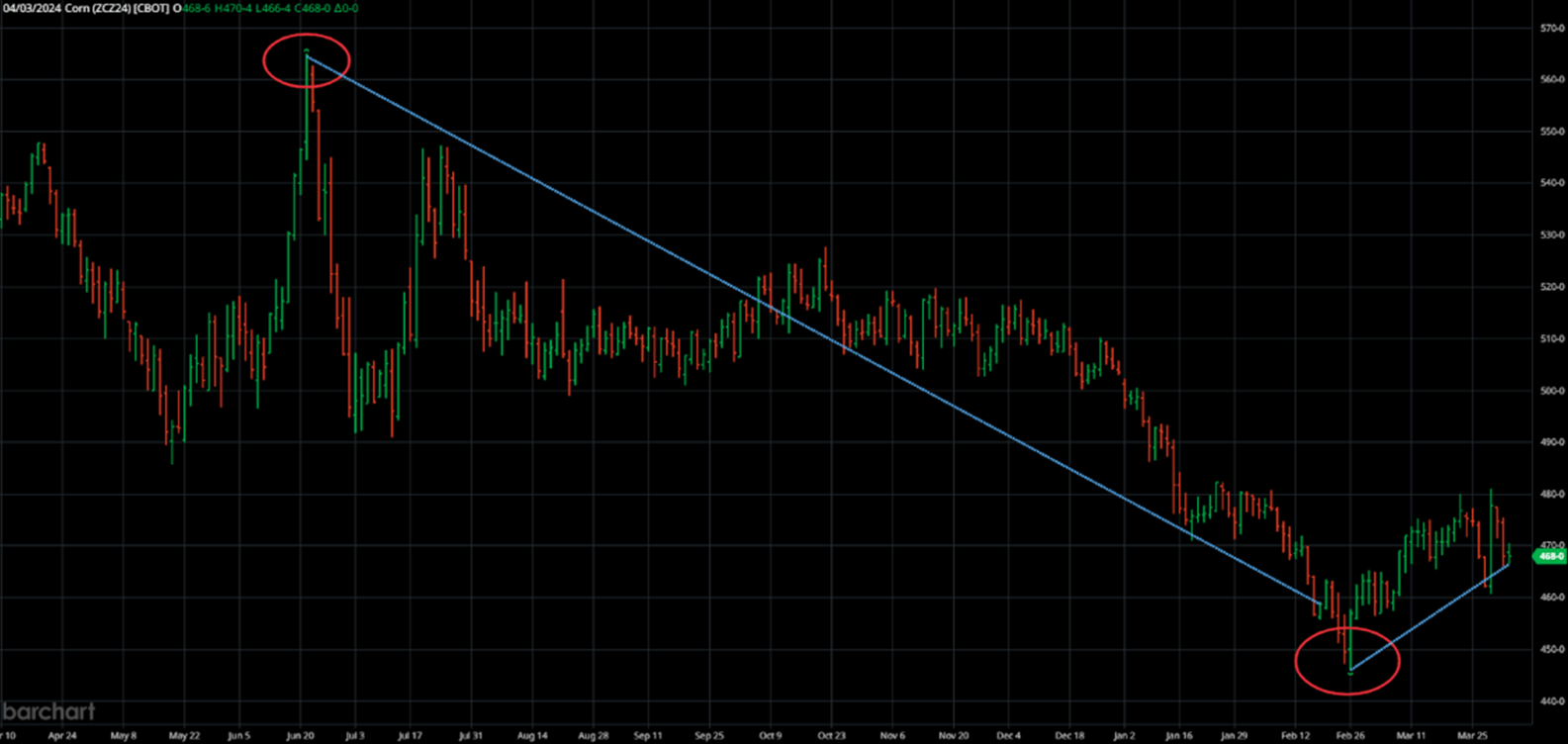
Grain markets have slid significantly from the highs posted last summer that followed the perceived drought in the Midwest.

Image Credit: Barchart: December ‘24 Corn Contract from June 2023 to April 3, 2024.

Unfortunately, these drought concerns were generally unfounded as key growing areas received timely rains to keep yields from suffering in the corn belt. In fact, the U.S. set a new corn production record at 15.234 billion bushels topping the previous record set in 2016 at 15.148 billion bushels. The trifecta of a record large U.S. crop, a large Brazilian corn crop, as well as underwhelming domestic and export demand sent prices spiraling lower from August 2023 to February 2024. The March ‘24 Corn contract traded at three-year lows on February 26th dipping below $4 following 11 consecutive week-over-week price declines.

Soybeans were unfortunately no better, falling $2.90 from their summer high ($14.18) to their low ($11.28) in the March ‘24 contract. Much of the same stories plagued this market including an unrealized weather rally and outstandingly large South American production that punished U.S. export demand.

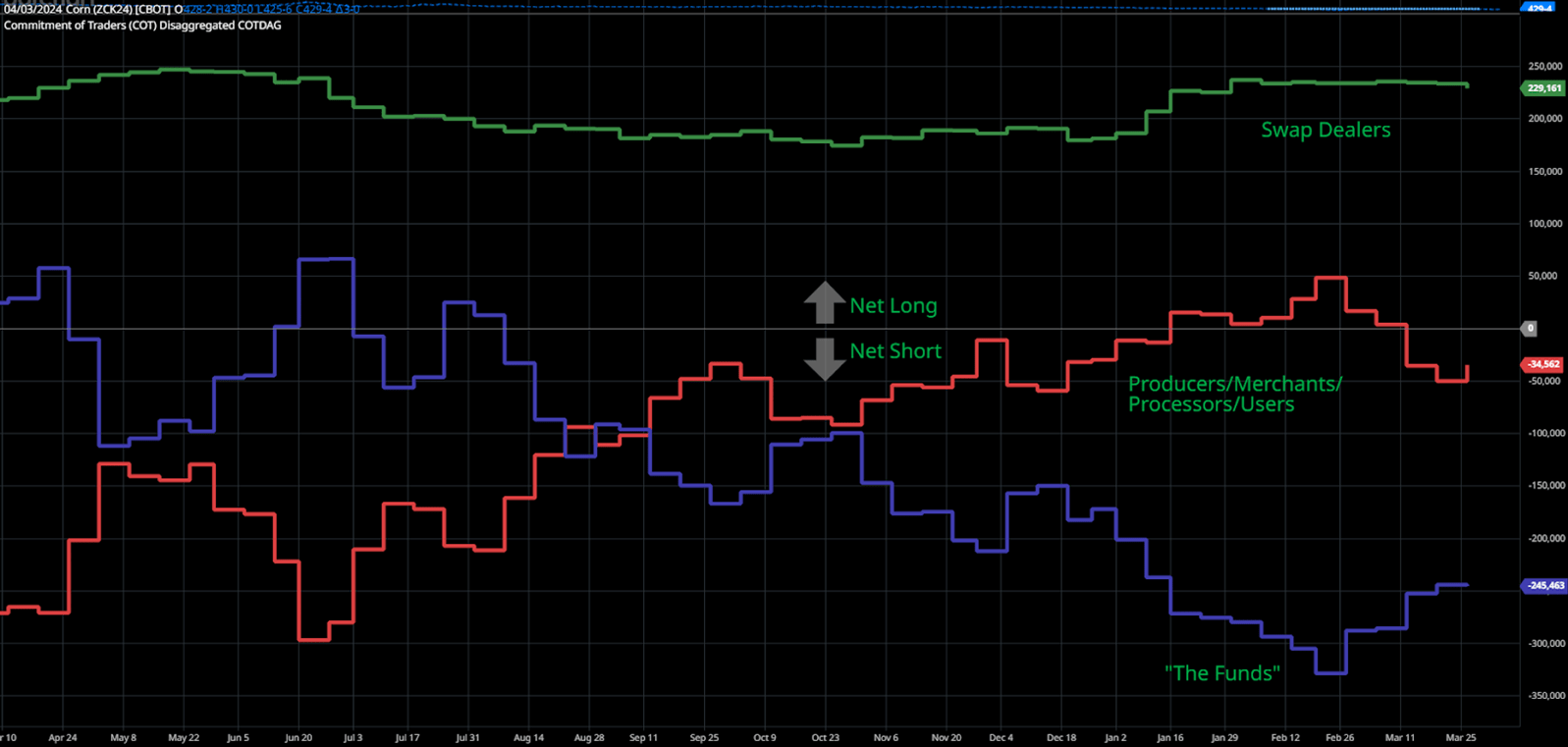
To add insult to injury, “the Funds”—traders in the market who manage money for clients as either hedges or other investment strategies hit a record 340,732 net short position in the corn market on February 20th. Simply stated, these traders placed the largest-ever bet on corn prices continuing to decline, which has placed a metaphorical wet-blanket on any hopes of a rally.

Today

Grains have rallied from the end of February and throughout March. The inflection point was the last day of notice for March hedge-to-arrive (HTA) contracts. To that point, sellers (farmers, dealers, etc.) had the choice of pricing corn at current prices or “rolling” the contract to the May contract. The bleak outlook forced many hands and stimulated selling which pulled prices lower until the selling pressure was over.

Since then, both the corn and soybean markets have rallied off the lows and recovered to price levels previously seen in early February. The upward momentum has been driven by a phenomenon known as “short covering” that creates a positive feedback loop–the more it happens, the more it happens. As prices rise, “The Funds” in their net short position lose money as their bet has turned against them. To stop this, they must exit their position by buying a contract to offset the one they previously sold1. The buying stimulates further price increases that induce another fund manager having to offset their short position. At its extreme, this feedback loop can throw prices to astronomical levels2. In this case, the bump is a welcomed change but is unlikely to send us much higher for now.

More recently, the USDA released its Prospective Plantings Report compiled from surveys asking farmers their planting intentions this season. The report suggests growers will plant 90 million acres of corn and 86 million acres of soybeans, indicating that growers are shifting acres away from corn to soybeans. This was unsurprising, however traders found this as good news as the nearby contracts in both markets traded higher the day of the report. However, traders are generally wary of this recent report given the low farmer response rate and the tendency for acreage figures to climb with subsequent USDA planting reports.
Season Outlook:

The saying, “all models are wrong, but some are useful” may hold true for commodity market predictions as well; there is a significant degree of uncertainty in any market that can render any forecast absolutely incorrect. As such, this is not meant to be a forecast but more of an observation of trends and conditions that may prove useful.

Supply and Demand Fundamentals

Image Credit: Barchart. CFTC Commitment of Traders in the Corn Market (all contracts).

Every market most fundamentally relies on the interplay between supply and demand. Currently in the grains, supply has outstripped demand. Following last year’s record crop, U.S. corn supply is almost burdensome.

A common metric that evaluates how efficiently we use the crop we grow is the Ending Stocks-to-Use (S/U) ratio derived from the USDA World Agricultural Supply and Demand Estimate (WASDE) each month. Currently, the USDA projects the 2024/25 ending stocks (that which we will not use from the crop we’re about to plant) at 2.53 billion bushels and an S/U ratio of 17.2%–a level we have not seen since the 2006 when corn traded at an average price of $2.62/bu. This current 2023/24 marketing year (ending Sept. 1, 2024) is currently pegged at 14.9% S/U ratio–well higher than the 7-10% range of the last three years and the 12.6% historical average.

The soybean side of things is only marginally better and certainly not rosy by any stretch. The current S/U ratio projection for this year’s crop is 9.9% with the current marketing year sitting at 7.6%. Both these figures are a far cry from the burdensome supplies we accrued during the 2018-2019 trade war with China (22.9% S/U) yet they signal a surplus of soybeans.

Market Movers

With the current fundamentals dreary at best, it’s pleasant to think of those things that could actually help prices higher.

  1. Midwestern drought conditions continue to worsen throughout the growing season. US weather conditions are a significant driver of price action in the growing season–as exemplified by last year. Currently, some of the Midwest is experiencing a moderate drought, with some agronomists questioning the subsoil moisture levels before planting. Importantly, drought conditions would have to persist throughout the growing season well past planting. Generally, drought is bearish to corn in April and May as Midwest growers can plant at a breakneck pace just in time for timely rains that pull yields higher and prices lower. As evidenced by last year, corn did not rally until late-May over weather concerns and in 2012, corn did not rally until mid-June. Both these years indicate that prices will likely stay mixed until real concern over crop condition emerges during the growing season.
  2. The South American (Brazil + Argentina) soybean production is lower than expected, improving export demand for U.S. soybeans. Soybean harvest in Brazil is nearing completion, however final production estimates remain volatile. The same is true with South American corn production: a supply-side shock could support U.S. corn prices. Brazil has completed corn planting this last week of its large safrinha corn crop. Currently, much of the key corn growing regions are in a minor drought or have experiences greater than normal rainfall. More serious and persistent crop-damaging weather events could certainly be a boon to the U.S. market.
  3. Recently, the Federal Reserve signaled that it will likely keep the Federal Funds rate higher for longer–increasing borrowing costs. If this holds true, investors may find themselves less attracted to debt and equity markets as companies may have a more difficult time generating earnings. Instead, investors may revert back to commodities–a market often seen as a hedge against inflation–as they did in 2022. As mentioned above, this may trigger a significant unwinding of short positions which could carry the market to higher prices. Unfortunately, this is likely the most unlikely scenario for increasing commodity prices as equities soar to all time highs in recent weeks.

So What Can We Do About It? 

Marketing grain in 2024 will likely be challenging on all fronts. Put another way, given the current outlook, it is incredibly unlikely that selling grain in the fall at harvest prices will be a winning strategy. Similarly, it’s unlikely that an unhedged, unpriced JFM ‘25 sale will offer anything better as there are additional storage costs involved. That said, developing a preharvest marketing strategy may very well be a key to success this marketing season. Betting on the aforementioned weather stories is hardly a marketing plan.

Like every year the first step is knowing your cost of production inside and out. Marketing opportunities will present themselves, but it will take knowing what is and what is not a good price. With today’s relatively high input costs, “yielding your way out” of low prices is more challenging than previous years. Therefore it may be more crucial than ever to make judicious agronomic decisions.

Take advantage of seasonal market patterns. Generally speaking, we see 3-6% increase in corn and soybean prices between mid-March and late-May from their post-harvest lows in January. As old crop marketing wanes, and concerns over the current year’s crop emerges (like the weather), prices rise slowly during this time. It may be best to price some grain sooner rather than later to take advantage of this general trend. Put it more directly; from May 1st to October 1st, corn prices fall more than $0.30, 74% of the time. Would you bet on something weighted 75% against you?

Track local basis. Generally, basis tends to follow broader market conditions especially when it comes to spreads between nearby and more distant contracts. Seasonal trends in basis also exist with harvest often being the low point and spring generally higher.

Keep a watchful eye on the markets this season. It may be such that prices are favorable for a day or two before they fall back lower.

Please also consider attending a University of Maryland Extension grain marketing meeting. These meetings are filled with all the above strategies, general information, and more that could help you with your marketing decisions.

Best of luck to you all. Here’s to blue skies and high prices!

Footnotes & References:

1 This may seem counter-intuitive. For a review on futures contracts please visit CME’s Self Study Guide to Hedging with Grain and Oilseed Futures and Options.

2 https://en.wikipedia.org/wiki/GameStop_short_squeeze

Maryland Regional Crop Reports: April 2024

Reports are for crop conditions up to April 5, 2024.

Western Maryland

Wet, wet, wet. This spring is off to a very different start than last year. Late winter and early spring have gone a long way in replenishing soil moisture and groundwater. Soil temperature and moisture will delay planting for a few weeks, but we are happy to have the moisture. Chicken litter, dairy manure, and first-pass nitrogen have been applied. These rains are now filling pits uncharacteristically. We are seeing Barley Yellow Dwarf Virus in some triticale. This is new since triticale was once thought to be resistant to everything. Next fall, we will need to think about scouting for aphids. All in all we are off to a better start than 2023.—Jeff Semler, Washington Co.

Central Maryland 

We’ve had quite the up and down with the weather this month. A few days in mid-March brought highs into the 60s, but most of the month has been cooler (lows in the 30s and highs in the 50s). In the past week, areas around the region have received 2 or more inches of rain. Soil temperatures have hovered around 50 degrees F. Green-up and manure applications have gone out. Looking forward to some warmer weather next week!—Kelly Nichols, Montgomery Co.

Northern Maryland

The past week has been cool and wet, which has been the story for most of the winter/early spring thus far. Field work has been very limited due to all the rain; second shot of nitrogen on wheat and weed control is needed as soon as the weather turns. Soil temperatures are still cool and the first seeds will not be going in the ground any time soon. Cover crops and small grains are generally variable across fields and winter annual weeds have been noticeably abundant this spring.—Andy Kness, Harford Co.

Upper and Mid Shore

No report.

Lower Shore

It’s been a wet spring, which has interrupted farm activities. Many fields are waterlogged or flooded. Farmers have been applying manure as they can get into fields. Most cover crops are still growing, which has been helpful to keep the rain water in the crop fields. No corn or soybean has been planted yet.—Sarah Hirsh, Somerset Co.

Southern Maryland

Rains continue to fall with only a few days here and there suitable for field work. Farmers are practicing patience as much work remains spreading litter/manure, applying herbicides and completing field operations. If weather conditions allow, planting will commence in a couple of weeks. Soils are wet and cold at present. Small grain crops are at jointing stage. Most wheat acreage received a first application of N with the second application being made when field conditions allow. Aphids have been active in some fields. Alfalfa got off to an early start this year, and growers are encouraged to scout for alfalfa weevil which has also been active. In So MD, most populations are resistant to pyrethroids, leaving Steward as the best option. Cool season grass hayfields are greening up now. On the weed front, Virginia Pepperweed seems to be more prevalent this year. Marestail and Common Ragweed are around and need to be controlled prior to planting. Burndown applications are being made in preparation for planting. With cooler temperatures, we may struggle to kill larger Italian ryegrass, brassicas, and cereal grain with standard rates of glyphosate.—Ben Beale, St. Mary’s Co.

*Regions (counties):
Western: Garrett, Allegany, Washington. Central: Frederick, Montgomery, Howard. Northern: Harford, Baltimore, Carroll. Upper & Mid Shore: Cecil, Kent, Caroline, Queen Anne, Talbot. Lower Shore: Dorchester, Somerset, Wicomico. Southern: St. Mary’s, Anne Arundel, Charles, Calvert, Prince George’s

UMD Grain Marketing Site Updated for 2024: Field Crop Budgets

Shannon Dill, Principal Agriculture Agent | sdill@umd.edu
University of Maryland Extension, Talbot County

The University of Maryland Extension has updated www.go.umd.edu/grainmarketing site with new input data and spray programs for the 2024 field crop budgets.

Crop Budgets

Cost of production is very important when making decisions related to your farm enterprise and grain marketing. Preliminary surveys from 2024 UME Winter Crop Production meetings report 66% of farmers believe input costs are the greatest challenges facing their farm operation. Enterprise budgets provide valuable information regarding individual enterprises on the farm. This tool enables farm managers to make decisions regarding enterprises and plan for the coming production year. An enterprise budget uses farm revenue, variable cost, fixed cost, and net income to provide a clear picture of the financial health of each farm enterprise.

The 2024 Maryland enterprise budgets were developed using average yields and estimated input costs based on producer and farm supplier data. Fertilizer prices, pesticide availability, and fuel expenses have fluctuated greatly. The figures presented are averages and vary greatly from one farm and region to the other. It is, therefore, crucial to input actual farm data when completing enterprise budgets for your farm.

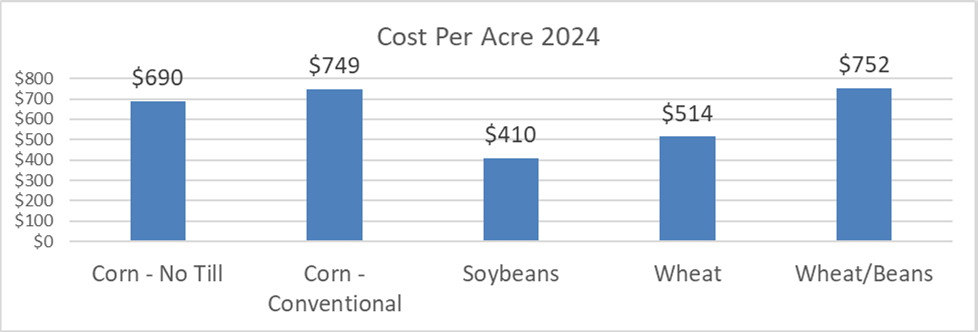
Cost Per Acre, 2024
Year Corn

No Till

Corn

Conventional

Soybeans Wheat Wheat/Beans
2021 $540 $592 $346 $401 $608
2023 $736 $800 $423 $538 $800
2024 $690 $749 $410 $514 $752
Difference 23-24 -$46 -$51 -$13 -$24 -$48
Percent Change -6% -6% -3% -4% -6%

How to Use University Enterprise Budgets

The enterprise budgets can be used as a baseline for your operation, and you can change these budgets to include your production techniques, inputs, and overall management. The budgets are available electronically in PDF or Excel. Use this document as a start or reference to create your crop budgets. Contact information is on the website if you have problems downloading any information.

2024 Crop Summary

Cost per acre expenses for 2024 have decreased a small amount from 2023 record highs. Based on estimates received cost of production includes: corn no-till costs $690 per acre, corn conventional $749 per acre, soybeans $410 per acre and wheat $514 per acre. While these are slightly (3-6%) lower than 2023 they are still 16%-22% higher than prices just 3 years ago (2021).

Considerations for Pre-Plant Applications: Italian Ryegrass

Kurt Vollmer, Weed Management Specialist | kvollmer@umd.edu
University of Maryland Extension

Italian ryegrass has been giving us trouble the past couple of years. I’ve had several reports of ryegrass control failures following glyphosate applications. Last year, seeds from 49 ryegrass populations from Maryland and Delaware were screened for glyphosate-resistance by Dr. Caio Brunharo’s lab at Penn State. Out of 40 populations screened, all were controlled by glyphosate at 2 lb. ae/A.

This indicates that recent troubles controlling ryegrass may be due to application issues rather than glyphosate-resistance. This species can be particularly tricky to manage this time of the year, so it’s important to remember:

  • Cold weather affects glyphosate uptake and translocation. Applications should be made when the temperature is greater than 55°F and consistently remain above 45°F for 3 to 5 days to be effective.
  • Higher rates will be needed to control ryegrass compared to other species (1.25 to 1.5 lb. ae a/A).
  • Plants should be less than 6” but no more than 8” tall at the time of application.
  • Other components in the tank can also affect glyphosate performance.

Include a spray grade ammonium sulfate (8.5lb. to 17lb. /100 gal) in the tank to abate water quality issues. UAN and high rates of triazine herbicides (>0.25 lb. ai/A), such as atrazine, that are included in the tank can also reduce glyphosate absorption and translocation.

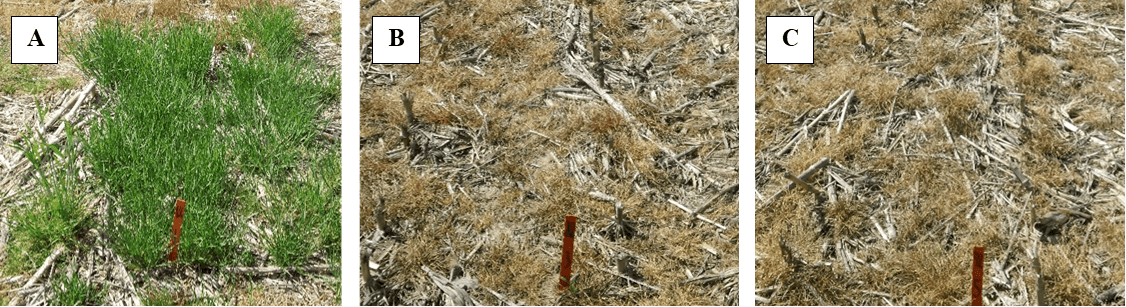
If glyphosate alone fails, try tank mixing or alternative herbicides. Last year at the Lower Eastern Shore REC, 98% ryegrass control was achieved with glyphosate (1.25 lb. ae/A) + clethodim (0.121 lb. /A) + nonionic surfactant (0.25%v/v) + AMS (8.5lb./100 gal) or sequential applications of paraquat (1 lb/A) + crop oil (1%v/v) + AMS (8.5lb./100 gal) made 14 days apart (Figure 1). In trials conducted in Pennsylvania, glyphosate + 0.02 lb. rimsulfuron/A also controlled ryegrass greater than 95%. Always consult the label for important information such as tank mixing and plant back intervals before applying any pesticide.

Figure 1. Italian ryegrass response 22 days after application to a) non-treated, b) glyphosate + clethodim, c) paraquat fb paraquat plots. Images: K. Vollmer, University of Maryland.

Hiring: Agricultural Technician

An Agricultural Technician is sought to provide technical support for the State Extension Agronomist with applied research and extension programming. This program performs applied research at seven UMD Research and Education Centers located across the state related to the production of corn, soybean, wheat, barley, and other crops of interest to Maryland producers. The incumbent may assist with research performed at private farms within Maryland. The incumbent will also assist with Extension programming, including preparation for field days, twilight tours, or other educational events.

To view the complete listing and to apply, go to https://ejobs.umd.edu/postings/117883. Best consideration date is April 4, 2023 and all applications must be submitted through the website. For questions or inquiries, contact Nicole Fiorellino at nfiorell@umd.edu.

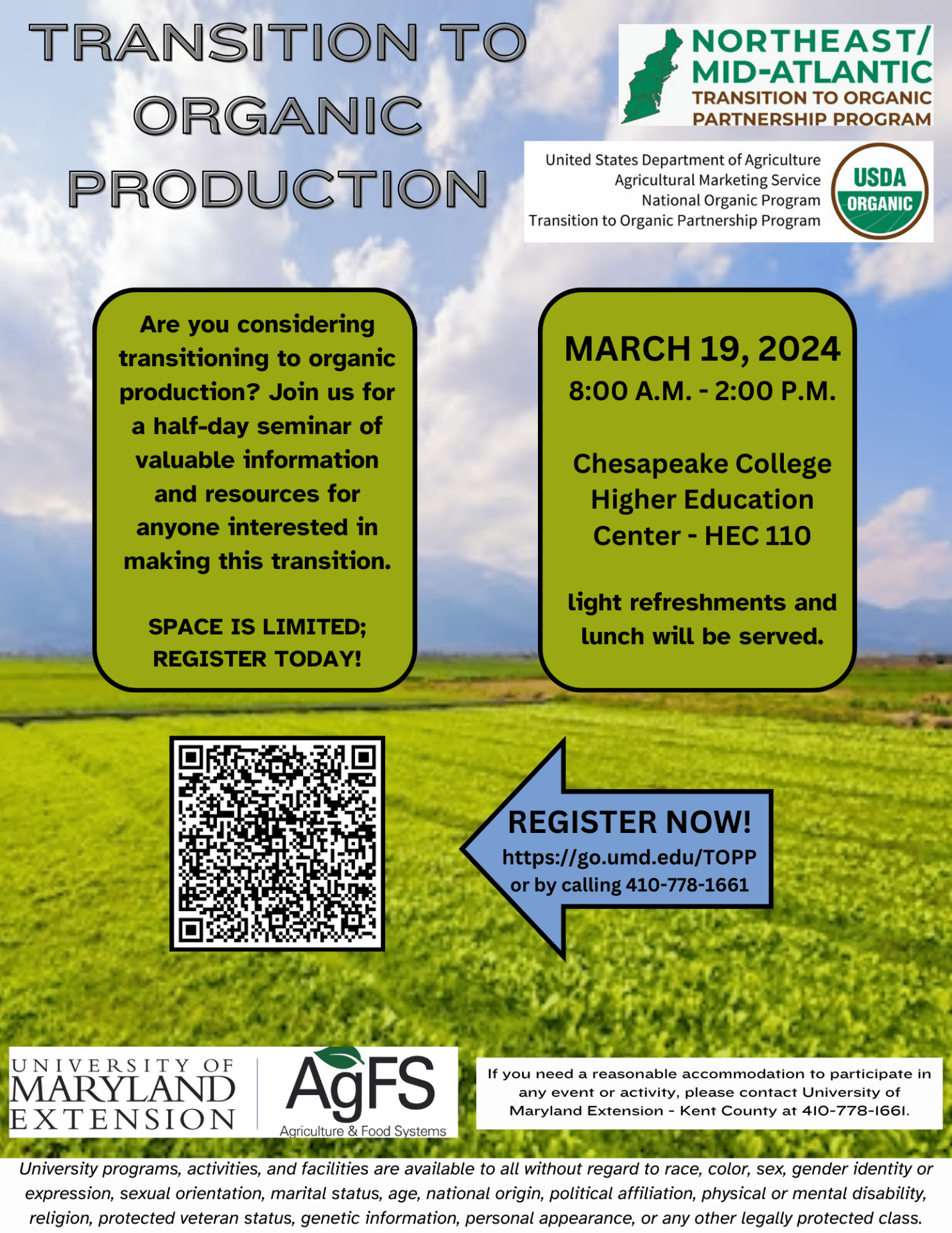
Transition to Organic Production

Are you contemplating a transition to organic production, currently undergoing the transition process, or just curious about organic farming?

The University of Maryland Extension invites you to register for a half-day seminar from 8 am to 2 pm on March 19, 2024 at the Eastern Shore Higher Education Center – Chesapeake College. The agenda for the day includes presentations by Klaas Martens, Chris Johnson and Brian Kalmbach covering key topics such as the direction and future of organic production, insights into organic grain markets, and navigating certification, regulations, and requirements. Additionally, there will be a farmer roundtable discussion featuring panelists representing various aspects of organic farming, including grain, vegetable, animal, and research. Light breakfast refreshments and lunch will be served. 

Space is limited so register todayhttps://go.umd.edu/TOPP

For more information or any inquiries contact Dwayne Joseph at dwaynej@umd.edu or by calling 443-480-8369.