Time and Space in Amulet

The concepts of temporality and spatiality reoccur throughout Roberto Bolaño’s Amulet. Both issues arise in the initial pages of the text, when the narrator writes, “I came to Mexico City in 1967, or maybe it was 1965, or 1962. I’ve got no memory for dates anymore, or exactly where my wanderings took me” (2). As Auxilio introduces herself, immediately the reader is introduced simultaneously to transnationalism, seeing as she is from another country and now lives in Mexico. “My name is Auxilio Lacouture and I am Urugayan—I come from Montevideo—although when I get nostalgic…I say I’m a Charrúa…and it confuses Mexicans and other Latin Americans too” (2). This confusion surrounding time and space engages the reader at the very commencement of the novel, demonstrating perhaps the lack of importance of specificity in regards to the when and where about which people are so often concerned, as well as the dynamic, innovative, and unusual structure to the text. While utilizing the first person is considered “normal” to texts, the narrator subverts this norm by expressing her thoughts in a manner more akin to a stream of consciousness, and later, expressing dialogue without quotation marks (as we saw in Cole’s Open City).

The narrator begins to explain her involvement in the events of 1968 on page 21, as she sits in the bathroom in the university’s Faculty of Philosophy and Literature. Yet after realizing the chaos that was occurring outside of the restroom, Auxilio specifically notes that “five seconds later, someone, maybe the son of a b**** who had spoken before, opened the door of the bathroom and came in” (27). So at this point, time and even space as Auxilio (“I estimate that I must have spent about three hours sitting there” (31)) sits in the stall are clearly marked for the reader; however, her time remaining in the bathroom becomes speculative. “Time folded and unfolded itself like a dream” (32). Auxilio’s memories (if the reader can be assured of the authenticity of said memories since she mentions over and over her confusion regarding them) become skewed, changing from the 60’s to 1956 to the 1970’s, and she leaves the reader hanging in the balance of the time spent in the bathroom, as she moves her narrative along, changing in time and space to discuss her specific rendezvous with Arturo Belano at the Encrucijada Veracruzana in 1970.

The reader is returned to that unspecified amount of time, thus a vague temporality, spent in the bathroom (here, a place firmly entrenched in spatiality) in September 1968, this time through the narrator’s own personal transnational lens: “I thought about those Asians crossing the Bering Strait, I thought about the solitude of America, I thought about how strange it is to emigrate eastward rather than westward” (54). Auxilio’s transnational lens (here, her affinity for British poets) reappears in her thoughts concerning poets, those who were teachers and pupils and those who didn’t live to become either. “I thought about the dead poets, like Darío and Huidobro, and about all the encounters that never occurred. The truth is that our history is full of encounters that never occurred. We didn’t have our Pound or our Yeats; we had Huidobro and Darío instead” (63).

Auxilio also touches on the idea of transnationalism in a paragraph discussing Mexico City’s poets’ voices. “No one could understand those voices, which were saying: We’re not from this part of Mexico City, we come from the subway, the underworld, the sewers, we live in the darkest, dirtiest places…” (78). Clearly, this vision of transnationalism does involve crossing countries’ borders, but rather focuses on the idea of a completely different culture of people (poets) living within Mexico City, explicitly different from the city’s other citizens.

Returning again to the concepts of temporality and spatiality, Auxilio’s use of the word “frozen” seems to represent a sort of “time standing still” situation. “The everyday is like a frozen transparency that lasts only a few seconds” (105). In taking apart the phrase, the reader recognizes aspects of time and space, i.e. “everyday” as something temporal, “frozen” in regards to space, and also “transparency,” which relates again to spatiality in that the everyday may exist, but if it’s transparent, ergo no one can see it, is it truly there? Does it, in fact, belong in the genre of spatiality? This confusion regarding space and time arises yet again in Auxilio’s thought process later on. “And that is when time stands still again, a worn-out image if ever there was one, because either time never stands still or it has always been standing still…” (126). While time here can once again be “frozen,” as noted before (an impossible characteristic of temporality), it is called an “image.” An image can be interpreted as a picture or a photo, and if viewed as such, the image therefore becomes a concrete object, thus rooted in the concept of spatiality.

The Impersonal Volition of Temporality in Teju Coles’ *Open City*

In his novel, Open City, Teju Cole conveys temporality–through both its form and its content–as an impersonal, indifferent, multi-directional, volatile force against which people struggle to maintain themselves.  Time is reflected as a dynamic expanse, comprised of material and reflected layers—the earth and it’s weather patterns, man-made structures, sound, memory, text, stories, and so on. These layers and reflections are constantly shifting; at any moment, in any space, or mind, a sudden fissure may break open, allowing the earth below to surge upward and overtake the surface. Although the newly emerging matter has always been there, supporting the surface, its new position alters the entire landscape. People have to navigate this unstable expanse. Some times, some people can sense a fissure—a blatant presentation of simultaneity.  They take note of shifts.  Other people, at other times, misinterpret them, or fail to notice them at all.  Apart from brief moments, or at least perceived experiences of a ‘bird’s eye view’ of this expanse, people are deeply and irretractably immersed in the landscape. Above, around, and within this expanse, with its moving people, is the inhuman, the elements—the sky, the cosmos, water, and life force.  It continues on, indifferent, yet directly impacting the traversal of people over the expanse.

Here, I will articulate four layers of the novel upon which the reader might ‘stand.’ Hopefully, in doing so, I will reflect how Cole’s volatile, simultaneous, histories cause the reader to lose her footing almost as soon as it is assumed to be gained.

1. Un-human Temporality

Throughout the novel, the narrator, Julius, directs the reader’s attention to un-human forces. These forces not only impact people, but influence their motions, shape what is perceive and how it is perceived. What is more, this un-human influence run so deeply that the motions of humanity itself, are reflected as an other-than-human mechanism.  In reference to cosmic and natural elements, such as the time of day, the season or the weather, Julius uses descriptions such as “unresponsive night” (54) and the “indifferent winter” (183).  In contrast to the impervious elements, the decisions and actions of Julius and his general trajectory, are highly responsive to those elements, in return.  Just as much, if not more,than his own mood or preference, the rain, wind, light and dark drive him from one street or interior to the next.  He takes note of these influences often.  In the Spring he writes, “I have noticed how much the light affects my ability to socialize” (193).  Recounting his father’s funeral, he remembers the impact of the stifling hot weather (224).  Julius is also influenced by people. He is repelled away by the gallery security guard and compelled toward others, such as the Czech woman in Brussels. Julius seems at times, to mindlessly float along these capricious paths motivated by external influences.  At others, he seems to do so with an accute awareness: “how petty seemed to me the human condition…this endless being tossed about like a cloud” (146). In one moment, as he lay in an ally, having been brutally beaten and mugged, the materiality of temporality, became viciously clear: “As I lay there, time became material in a strange new way: fragmented, torn into incoherent tufts, and at the same time spreading, like something spilled, like a stain” (212). As the reader follows this narrator, who merges, sometimes seamlessly, sometimes jarringly, through others voices and other times, the novel begins “spreading…like a stain.” This spreading, upward and across, creates the sense for the reader, that she trapped in the limited perspective of a person deeply immersed.

2. Led by the Senses: Layers of Sound

Woven throughout Open City, the perceptions and actions of weather-affected human-machines are also described as being dependent on the senses. One of the senses of focus is the auditory. The novel is brimming with competing noise—the radio, the clatter of a briefcase, the symphony, and the rain on the roof.  These noises, like the temporal landscape, approach and recede, combine and separate or repulse or attract.  Even the absence of noise, seems at one moment, to be crippling, and at another, suggestive of some sort of posthuman connection.  Depending on a person’s situation, predisposition, preference, and the circumstance of that very minute, he/she will tune in or tune out, respond or not respond, to sound.  Competing noises in this “open city” sound uncertain, ethereal conflicts.

When Julius hears the chant of protestors, speaking out against violence against women, he closes the window (24).  But, as if their cries had drawn him into his past, beckoning his reach, he calls his ex-girlfriend. Her voice, in contrast with the self-assertion of the protesters, is “strained,” singular and distant. At moments like these Julius seems to be feeling something, but it is not clearly articulated to the reader, or perhaps, to himself.  At other moments, most specifically in relation to music, sound both constructs his mood in one sense, and shelters him from embedded emotion, in another.  Toward the beginning of the novel, Julius’ reaction to music playing overhead at a record store, further immerses him into his perceived present, fostering connections and pathways: “…every detail had somehow become significant…somehow seemed a part that intricate musical world” (18).  Yet toward the novel’s end, in the present tense, he has an emotional response to a symphony that seems to draw him out and up.  Over the world.  Both of these responses, nevertheless, inspire a response.  Yet when faced with words of conflict, such as Moji’s rape accusation, he responds not only with external silence, but with internal silence as well. He says and writes nothing.  Not to her.  Not to the reader.  Instead he leads into chatter about Camus (246), to fill the silence.

3. Perceived Volition of Humans across Layers

Within the novel, we are alerted to how people select–sometimes with intention, but most other times via causes outside of their control–how they will negotiate time.  People write papers, books, tell stories, post words, and name word. Julius tells his reader, “Names matter.  Everything has a name” (233).  It is difficult to know if Julius is critical of this “matter,” or is indifferently naming it as a reality. There is a moment wherein he thinks that the human forced resolve to self-knowledge, or to put it in his words, to “articulate ourselves to ourselves,” is “perhaps…what we mean by sanity” (243).  And in the same way that donors donate to put their names on buildings, to be not only named, but named as heroic, Julius suggests that sane, articulate, people must make themselves the heroic protagonist of their own story, not only for themselves, but for others. To earn their own trust and the trust of others, or, the “sympathy of an audience” who is “ready to believe the best about us” (243).  Julius successfully earns his own trust; he assesses himself as “hewed close to the good.”  And he may have successfully earned the trust of his reader. He narrates this concept of sanity and self-heroism right before (potentially) violating the reader’s trust by recounting Moji’s rape story.

The reader cannot know if her story is true. We know nothing, but that Julius has nothing to say. That being said, suddenly moments in previous chapters emerge in our memory, reshaping how we interpret the present.  The reader is becoming one of the people being tossed around through the pages. As the humans being depicted lose their place as the master of the universe, the reader finds it difficult to project blame. Because, In which direction would it be launched? Julius, and the “open city” are always on the move.  And each place and moment alters perspective.  Julius goes from the 3rd floor of the professor, to the subway below ground to M’s apartment on the 29th floor.  But even within one level, the experience changes, from on train to another, from one day to the next.  The heterogeneity not only spreads, but also collapses. The narrator describes the layers of the city.  He uncovers time past, that is still in the present, only lying, unacknowledged, below.  Time passed also rises above, layers of history piled high, in the midst of swarming people too caught up in their perceived present to notice: “the grand columns and arches irrelevant to the fatigued immigrants who rarely raised their heads to look above street level” (235).

The human memory is also presented as unreliable and unpredictable–unplaceable. In almost the same manner that one cannot predict how the weather will change history, the human cannot know within which time he/she is functioning.  In a memory, a launch into a past that is thrust upon the narrator, and his reader, we are brought to his mother’s response to her husband’s funeral.  Within that memory the reader is launched into her memory, which recedes further and further.  She speaks in “a faraway voice, because it could not talk about the death that had just shattered us, had begun to describe long-ago things” (79).  Although circumstances can uncover hidden pasts, like an ATM number, it can also veil them, like the rape of a friend’s young sister (167).  Temporality becomes dependent on what humans can access, what they are willing to access. Yet, how can one access a moment in time, when time is in constant simultaneous motion?  Different pasts suddenly collide, like the “echo” of Moji and Nadège: “two individuals separated in time and vibrating on a singular frequency” (61). Julius critiques the view that time is a continuum, saying that “The past, if there is such a thing, is mostly empty space, great expanses of nothing, in which significant persons and events float” (155).  And suddenly all of these reflections and assertions of the past that creates the present, are mere reflections of nothingness: “the world doubled in on itself.  I could no longer tell where the tangible universe ended and the reflected one began” (192).

The author simulates this folding over in time, its confusion, by using dialogue without quotations, that merge into the dialogue of others as well as non-spoken thought.  How could these voices be clearly distinguished? They are layers of reflection, with an absent author, putting the words of fictional characters into the mouth of another fictional narrator, who dictates to an unknown reader.  How is the reader to designate one, true voice or story?  Perhaps she shouldn’t.

4. The Ephemerality and/or Fiction of Seeing from the Outside

There are brief glimpse in the novel of an outside, an apartness from the volatile landscape.  If not homogenous, or overarching, it is a frictionless calm and is something that Julius seems to privilege. Throughout the narrative, Julius expressed enjoyment in high vantage points, where he can “take in, in a single glance, the dwellings of millions” (240).  Toward the end of the novel, after Julius begins speaking in his present, he describes a brief moment of wherein he experiences a sense of the vastness and depths of history.  This experience–created by a combination of the emotional high from hearing a symphony, the bodily rush of being high up on a fire escape and having an uncommonly clear view of a starry sky– lead Julius to understand that, despite his inability to perceive them all, there was a vast expanse simultaneously existing stars: “But in the dark spaces between the dead, shining stars were stars I could not see, stars that still existed, and were giving out light that hadn’t reached me yet, stars now living and giving out light but present to me only as blank interstices” (256). Cosmic matter and human history merge together, and the reader is ready for the novel to articulate connection, finality.  But, the moment is quickly lost: “I had come so close to something that it had fallen out of focus, or fallen so far away from it that it had faded away” (257). Julius looses, once again, his sense of proximity. And the reader is bellied a fastened, stabilizing summation of the story.  Because it simply cannot be.

.
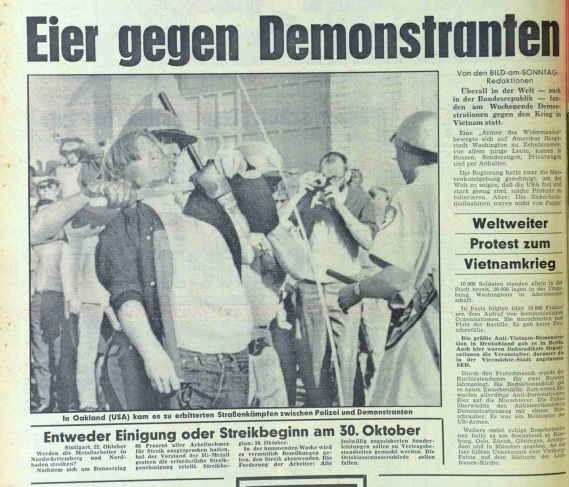
Agency and Imagination in 1968

Eier Gegen Demonstranten

The above article appeared in the German Bildzeitung on October 22nd, 1967, with the headline translating roughly to ‘Eggs against Demonstrators’. The supporting image shows the snapshot of a student protest occurring in the United States. As can be expected from any sensation-seeking tabloid, the global protest phenomenon was described as an “army of opposition… extending to the capital of the United States (Washington D.C.).” It continues to list (mostly peaceful) student demonstrations in cities such as Munich, Paris, Oslo, and Amsterdam.

I specifically chose the above article in an attempt to visually portray that both benefits and limitations can be found in viewing the events of 1968 as a transnational occurrence. After the many discussions we have had thus far on notions of transnationalism, I immediately felt a strong opposition to the thought of historicizing the events that occurred in 1968 into the scope of a single year. Starting with the stark contrast that several scholars place between transnationalism and the advent of globalization, in addition to the heated debate of the role that the past should or should not have in examining the contemporary and beyond, I have come to an understanding of the term ‘transnational’ that includes broad historical contexts and narratives that span across real and imagined borders.

In 1968 in Europe. A History of Protest and Activism, Klimke and Scharloth speak in support of situating the events of this year within the historical framework that led up to what we now collectively call 1968. Above all, they make a valid point in arguing that “The roots of many of these movements reach back to the beginning of the 1960s and the previous decade.” In their opinion, the year 1968 “thus stands as a metaphor used to capture the broad history of European protest and activism “ (Klimke and Scharloth 3). I absolutely agree with positioning these events within a broader historical context; one that shaped the imagination and agency of protestors for years prior. However, a considerable fault can be found in their focus on events that unraveled exclusively in Europe. While historical context plays a large role in understanding the transnational, the movement of ideas across borders may hold the same, if not greater, valence. Klimke and Scharloth do support a semi-transnational framework by mentioning that “Mediated exchange between student organizations from all over Europe lead to a permanent diffusion of ideas (Klimke and Scharloth 4).” However, how ‘transnational’ can such an assumption be without considering the diffusion of such ideas beyond European borders? While the introduction of the internet and rise of social media strongly facilitate imagination and collective identity across borders in the 21st century, such an exchange is also made possible and demonstrated in 1968 through means of media such as the Bildzeitung. It is crucial to remember that ideas move back and forth between borders fluidly, creating a productive exchange. So just as the German readers of the Bildzeitung gained a sense of transnational unity from the reports of protestors across the globe, consumers of media outside of Europe gained the same sense of solidarity by their consumption of media coverage about the European movement.

While considering 1968 as a sole temporal standpoint has proved problematic as situated above, it cannot be denied that focusing solely on the year 1968 in regards to transnationalism reaps the benefit of giving agency to a collective movement of people sharing similar perspectives. While the idea of agency is not always parallel to choice, these movements and protests transcended borders by standing in a simultaneous opposition to differing oppression. The transnational reality of this movement was further enhanced by what Appadurai coined as the ‘mediascape’. In this context, the above article from the Bildzeitung demonstrates the ability of the media to transform our imagination of reality. The main actors during the 1968 movements found strength in seeing and thus the imagining of social lives and social projects across the Atlantic. Witnessing these other ‘elsewheres’ created a sense of community in protesting injustices on a transnational scale. In Revisiting the Revolution: 1968 in Transnational Cultural Memory, Klimke describes the result of this collective imagination as giving “rise to a collective identity based on political orientation, socio-cultural allegiance and the vaguely defined image of generational cohort” (Klimke 32). Through circulation of these mediascapes, we thus see the imagining and creation of an identity that stands in solidarity against oppression, an identity that transcends both borders and time.

To summarize, it becomes apparent that regarding 1968 as a temporal standpoint in a transnational framework holds both benefits and limitations. The prominence of the year 1968 cannot displace the fact that many vital events occurred prior to, and led up to, the culminating key movements. However, the focus on the events of 1968 also gives this movement an unprecedented agency by understanding how the exchange of ideas across transnational borders facilitated a collective imagination of opposition.

__________________________________________________

*For those that may be interested in German media coverage of 1968 events, Axel Springer published a searchable database that includes media coverage, comments, letters to the editor, political cartoons, reports, and interviews from 1966 to 1968. You can find it here.

1968: Defining an Indefinable Moment

            For one who studies France, the events of 1968 certainly hold a place of prominence.  However, and I may be exposing a bit of historical ignorance in admitting this, it has been very interesting to learn the extent to which the 68 protests spread beyond France, beyond Europe, and the similarities and differences that exist in the way in which the spirit of 68 manifested itself.  As a moment of global protest, it is understandable why this year holds such an appeal in transnational studies.  Appadurai’s Modernity at Large excitedly discusses the beginning of a transnational change becoming possible due to advances in mass media technologies, but this report comes nearly thirty years following the events of 68.  These protests, and the cultural, economic and political shifts that they provoked, occurred in a greatly different landscape for technology and media.  The spirit of 68 also did not necessarily involve the movement of any people in particular, nor was it an ideology spread through a specific intellectual work.  The spread of protests in 68 was of a very immaterial nature, and thus represents an intangible transnational process.  To study the events of 68 is to analyze a much less visible transnational phenomenon than people crossing borders or using the Internet to speak to one another.  1968 was a very visible moment, not dependent on any particular location, people, or means of communication, but I believe its true value is symbolic.  1968 is the representation of a diffuse and broadly applicable moment of transnationalism.

That the year 1968 is so evocative of rebellion and protest for so many people, regardless of national or cultural boundaries, is in itself reason to consider what it adds to the idea of transnationalism.  As Martin Klimke notes in Revisiting the Revolution, the general memory of 68 is something that goes beyond borders.  He notes “…there is, in addition to our national recollections, also a transnational pool of memories.  In fact, icons, images, references, and experiences associated with ‘1968’ have been circulating across national borders ever since this turbulent decade.  They have created a loose, but nonetheless potent generational identity as well as a firm imprint in popular culture that transcends national boundaries (27).”  I believe it is fair to say that 1968 is a broadly shared memory held by people regardless of location, and even by those who were not there.  However, despite the broad spread of events in 1968, not all manifestations of 1968 were reacting to the same thing, or working towards the same goal.  In Reading Mexico 1968, the author cites a fictionalized German participant from Luis González de Alba’s Los días y los años who states that the demands of a Mexican student participating in a protest in the year has demands that are, to the German, incomprehensible (303).  The effects of 68 were broad, and are held by a great variety of people, but care must be taken when analyzing it so as not to take the great deal of similarities as indication that 1968 represented a unified vision.

Another potential hurdle in choosing one year to be representative of a transnational process is coming to terms with the fact that a broad phenomenon cannot sit so neatly in a well-defined spatial and temporal context.  Though 68 is the emblem of national and transnational protest in the 1960s, it cannot be removed from the context of what occurs before and after.  In 1968 in Europe, Klimke and Scharloth note the metaphorical significance of 1968: “The roots of many of these movements reach back to the beginning of the 1960s and the previous decade, making a strong case for extending the general periodization to the ‘long 1960s,’ dating roughly from 1956 to 1977.  In this book, ‘1968’ thus stands as a metaphor used to capture the broad history of European protests and activism… (3).”  Sarah Waters similarly notes the strength of 68 being applied more metaphorically: “Thus, recent comparative studies use a wide historical lens, taking 1968 as a symbol for a far larger moment in time (Introduction: 1968 in Memory and Place 2).”  The use of a specific year like 68 in analyzing a transnational phenomenon should thus be done carefully, with more regard to a defining moment in a larger process rather than a specific moment that exists in a vacuum.

The interest in 68 is important for the study of transnational processes.  It shows that something as abstract as the idea of protest can spread through national boundaries, and can do so without Twitter or Skype to facilitate communication.  It shows that transnational movement is not dependent on the current mass media landscape.  It has existed, continues to exist and presumably will continue to evolve and manifest itself.  However, there are pitfalls in limiting the study of transnationalism to such a specific time.  As noted, care must be taken to avoid generalizations.  Though 1968 was defined by global student protests, what these students were protesting for is not at all uniform.  Nor is 1968 a specific moment that exists out of time.  It is situated in a much longer history of rebellion and protest, and it is important to consider it in context of what lead to it and what changes it caused.  Still, for the study of something as broad, diffuse and potentially transparent as transnationalism, I believe that there is value in using specific emblematic moments of change.

A Semiotic Splice? Graphic novels as alternative history.

Through her use of the graphic novel genre, Satrapi strategically seizes control of the reader’s imagination. For years Satrapi was forced to ingest the images and cultural artifacts imposed on her from without by the Islamic Republic of Iran. Indeed Satrapi uses the graphic novel to coopt the images, signs and history that the Islamic Republic of Iran exercised over her and her people. By illustrating her memories as a subaltern Iranian female, Satrapi aggressively contests the Islamic Republic’s sole claim to write history.

Through her illustrations Satrapi creates her own – as Chakrabarty calls it – “alternative histor[y] in the heartland of ideology” (113). While Kraniauskas focuses on alternative temporalities to “global narratives of capital”, Satrapi’s novel comes closer to formulating an alternative temporality to the totalitarian fundamentalist Islamic regime;  “- in other words, [Satrapi successfully enunciates her own] cultural practices rather than mere false consciousness” (113). Both Kraniauskas’s and Satrapi’s conceptions of temporality challenge the hegemonic narratives imposed on the subaltern from without.

Parry (1994, 5) emphasizes the ‘enunciative act’ more than the substance of the narrated event. Likewise Bhabha (1994) is more interested in the enunciative process that creates a cultural difference which in turn challenges any single person’s, group’s or regime’s claim to cultural authority (118). While Satrapi’s narration of the Iraq-Iran war and other historical events is important, these events form the backdrop to another history: that of a female who bravely sets out to live her own life.

Through the enunciative act of her graphic novel, Satrapi causes disjunctures in the hegemonic temporalities of both European modernity and Islamic fundamentalism. Too Iranian for Europe and too European for Iran, Satrapi manages to forge her own hybrid identity and struggles to stop outside forces from shaping her subjectivity. To this extent then we can talk about alternative temporalities in two regards: that of the subaltern to the hegemonic and that of the interior to the exterior.

Satrapi exists in what Bhabha refers to as “hybrid time”. The image that Dr. Baer showed us with the split Socialist/Islamic imagery and corresponding unveiled/veiled Satrapi demonstrates how she had to inhabit different temporalities simultaneously. Likewise, the Islamic Republic’s “attempt to dominate” the cultural images was an attempt to shape individual’s subjectivities from outside to inside. Satrapi’s graphic novel is revolutionary to the extent that she cultivates her own semiotic language to challenge from the inside the external hegemony of the Islamic Republic (118). It is she and not the oppressive government who employs the signs, images and language to narrate and describe historical and cultural events. According to Marx and others it is the ruling class who controls the images and cultural artifacts, and so Satrapi’s use of graphic novel as an alternative form of historical narration is very radical.

Each cel of Satrapi’s graphic novel could be said to represent a point of disjuncture from the Islamic Republic’s writing of history. Furthermore, by aligning each disjunctive enunciation in her own desired order she is creating an alternative temporality that is based on her subjective experiences and memories. According to Bhabha “disjuncture – the return of the colonial repressed – happens in and through the present of enunciation” (121). Like splicing a broken film reel, Satrapi uses her graphic novel to cause a “temporal break in representation” and use her own images to create a hybrid history (121).

While abroad in Austria, Satrapi undergoes dramatic physical, emotional and psychological changes. Furthermore, she had accumulated cultural experiences that were at odds with the historical trajectory of the Islamic Republic. Her return to the Islamic Republic was akin to stepping into a time warp: having enjoyed the European luxuries of modernity for several years she would later return to a largely unchanged Islamic Republic, one which repudiated her new-found feminist identity. Both Europe and the Islamic Republic offered two different versions of hegemonic temporalities: one modern and capitalistic and the other archaic and religious. Like the Colossus of Rhodes, Satrapi straddles both temporalities and in so doing enunciates through language and images her own subjective understanding of history, a third space through which the reader can traverse.

“México, 1968: (Re)visiting and (re)memorizing the (Trans)nationalism.”

When, on October 2, The Plaza de las Tres Culturas in Tlatelolco was silenced by the massacre of hundreds of students, the majority thought that it was an isolated event, mainly because the day after the blood was cleaned from the streets and the Olympic Games were celebrated fifteen days later. However, the student movement was highly relevant both for the world and for the own Mexicans. Mark Kurlansky denominated the global event “The year the world awoke”, and there are also other expressions like “The year that rocked the world,” and “The year of the barricades.” However, while many youth historians believe that it is a myth or a symbol expanded by young activists, others like De Groot doubt that the narrations of 68 were completely true. This is the essential problem of the movement:  historization (objective) versus memorialization (subjective). It is obvious that scholars show their concern about both concepts and think about how to solve a story told by testimonies, voices, political appropriations, incongruities…because the event becomes controversial. For that reason, whenever there is a collective trauma, a collective memory is required, but also “imaginary spaces” in which to leave all that which cannot be proven with exactitude, so that the information is exhaustive and arrives and a truthful historicity.

It is precisely those myths that form a transatlantic position/reading. There were more events that year in Europe. In France, for example, the official history has been reduced to a cruel riot, and in Germany, the student rebellion was oversimplified. Despite of the inaccuracies and difficulties of knowing what happened, it is essential to take them into account because the memory of ‘68 is the reflection of the postwar change and of modernization. It is also the mirror of the intellectual and political concerns of a culture and localizes the threats of a common national identity. The events that took place that year are deeply international because they interact with other movements around the world.  Warburg says that all of these movements transcend national borders in their attempt to create an order in the world.  1968 was also “a magical year” because it “collects” the previous events-after the war- and provides followers of the movement or prophets,- like Marjane who “wanted  justice, love and the wrath of God all in one.” Many countries took social constructions from México to create their (transnational) framework because of the spirit of revolution. This spirit crossed borders through the ‘68 commercialization, which is why icons like James Dean, Rock ´n Roll, or The Beatles came out. The commercialization of youth culture is part of the articulation of the 60s and it is also the representation of dissent: Nike used The Beatle´s song “Revolution” to promote their sneakers. Therefore, we have to establish a truly global perspective to create a comparative framework and get the great transnational dimension of ‘68 in our collective memories.

Regarding the national framework, Pierre Nora advocates the “lieu de memoires” to reconstruct history through fragments of the past like monuments, physical objects, costumes, etc, to construct identity. In Mexico, there is only a mural that commemorates that day, however many writers write about the Plaza de las Tres Culturas, describing the Mexican streets and places that provoke a nostalgic feeling. The chronicler Carlos Monsiváis states in his article “The Passion of the History” that: “We have History because it is our Nation and the proof that we have a Nation is that History is already ours.”

Mexico shapes its analysis through commemorations, protesters- “October 2 is not forgotten”- and literature. Fernando del Paso, María Luisa Mendoza, González de Alba, Elena Poniatowska or Bolaño are some of the writers that tell about Mexico, 1968 and support Nora´s notion about the event; “literature about the student movement, especially because of the specific conditions in which it emerged, eventalised 1968.” Last year, Poniatowska received the Nobel Prize for her work, La noche de Tlatelolco–a crude testimony of the repression against the students. The interviewer asked her about the literary references and she confirmed that the chronicler Monsiváis and their followers were the best narrators because “they mix their own life with the chronicle” and added that “that´s why journalists have opportunities of writing everything they see beyond themselves.” Although González de Alba, former student leader and one of Poniatowska’s sources, said that his words were distorted (imaginary spaces?) by Poniatowska, others supported her. Literature is sometimes controversial, however. Mexico shows its national framework with the recent 132 movement or the earthquake in 1985, that Poniatowska confirmed as the moment that moved her the most because of the citizen mobilization: “One of the few moments in which Mexico was able to look at itself and more over, overcome the tragedy.”

Mexico is in the trilogy–identity, memory and heritage–which are the most important concepts to be framed in both national and transnational contexts.

“Who we are here today is born of what happened there yesterday”

I have always heard that history progresses slowly, taking two steps forward and one step back. I have also heard that history can vary depending on which voice is speaking; each country in this world has its own version of official history and true history. Even though we still question what history is and what it is not, or how history is and how it was and how past events have repercussions today, in order to make collective decisions we need to create memory and know what we were in the past, what we are now and what we could be in the future. “World history” is a transnational term itself: it encloses borders and cultures and it seems to be the product of events, wars, rebellions and political forces across the cultures that compound the world’s space and time. All of these ideas came to my mind while I was reading the articles for this week. But how did the past determine the present? How is it that a single event in one place could be spread and determine a decade? And how could it change the world order?

According to the readings assigned, we move back to a particular year in a “recent” past in a postwar context to 1968, considered to be the first global and transnational rebellion which revealed itself in several places (such as in Mexico and Europe) and that continues to have relevance in a closed present time. But the results of 1968 are also a construction of imaginary spaces that embrace contradictions and complexities even today. Studies of memory, history and identity such as “Introduction: 1968 Memory and Place” claim a lack of attention to this year and how societies have constructed different ideas and interpretations of it–sometimes it was sold as a myth and an utopia– and also how it has been used and manipulated by political interests. Waters and Cornils emphasize the importance of this year, a rebellion year that was also focused on equality, and they pose a reconstruction of this year as memory through a collective consciousness and the creation of a transnational memory. In addition, the memory of 1968 could provoke a broader questioning that would redefine national and historical experience, locating the threads of a common national identity or opening it as an international movement.

In “Revisiting the Revolution: 1968 in Transnational Cultural memory”, Klimke  focuses more on the different levels of 1968 and how individual acts differed from country to country but at the same time was part of a larger social framework that constitutes memory, a social memory. The year 1968 created national recollections and transnational memories such as icons, images, references and experiences. The ‘sixties’ was an important decade for liberal ideas and the development of new trends in academic disciplines. The year 1968 was a transnationalist year that echoes other countries, a year that cross borders. Klimke describes “1968” as a central part of globalization.

There is no doubt that 1968 was a highly remarkable year. It encapsulated a phenomenon that sailed across the Atlantic Ocean. The introduction to the article “1968 in Europe A History of Protest and Activism, 1956- 1977” Klimke and Scharloth state that 1968 constituted a protest movement that had transcended national borders in its attempts to realize an alternative society and world order. 1968 was as a “transnational moment of crisis and opportunity.” It provided a window to the panorama of European experiences during and after this year. Protest techniques were a widespread resource for mobilization and were only selectively adopted according to to structural opportunities available in each country. The movements of 1968 influenced others and have been the foundation, icon and model for others today that call for rights and equality.

However, political forces tried to “forget 1968”. Others have seen the year as one of modernization and prosperity; a year with benefits and limitations depending on the voice who speaks, on who experienced it or not. Every event tries to find a place and space in history and even its reflection in our days. Today we have twenty-five years distance in time from the fall of the Berlin Wall, an event which also has limitations and benefits but that changed our civilization. It was also emblematic of the physical removal of a city and a distinguished date in the calendar of 1989 that chained other events and became a transnational event due its consequences.

The Fall of the Berlin Wall and the subsequent disintegration of the Soviet Union are facts that changed the world order. When the political leadership of the Soviet Union was renewed and Gorbatshov came to power, an economic system reform was carried out. The reforms in the Soviet Union, the division and the emergence of countries like Romania, Bulgaria, and Czechoslovakia contributed to the end of the communist system.
The fall of the Berlin Wall led to the unification of the “two Germanies” physically separated by a “frontier”, and in the Gorbatshov reform it joined two systems clearly dividing the world: the communist and the capitalist. Later, these facts influenced internationally crossing borders reaching even the Chinese communist regime that even now is still “communist”, yet has adopted a market economy, a capitalist system.

The fall of communism and the access of communist countries to the capitalist economy make the world change economic structures and their functions according to a more globalized world order. However, a paradox emerges today: on one hand, a globalized world with its economic and financial integration, trade liberalization and the revolution of knowledge appeared –also called the technological revolution– with its icon: the Internet. On the other, more social divisions have emerged from this revolutionary period.

Everything in history is interconnected and defines the present. Everything that supposed a change in the world order remained relevant and became a symbol, an icon, a set of principles and archetypes. Images and symbols of Che Guevara and Communism or flags with the hammer and sickle could be seen in contemporary protests. They are a decoy of ideals, freedom of speech and reminiscences of world changing events and (trans)national forces.


1968: The Year that Rocked the World

Borrowing my title from Mark Kurlansky’s critically acclaimed historical text, 1968: The Year that Rocked the World (2004), underscores the global impact that this year has had. He introduces his text stating that “there has never been a year like 1968, and it is unlikely that there will ever be one again. At a time when nations and cultures were still separate and very different – and in 1968 Poland, France, the United States, and Mexico were far more different from one another than they are today – there occurred a spontaneous combustion of rebellious spirits around the world” (xvii). Addressing the question of examining the benefits and limitations to focusing on one year in regard to transnationalism, Kurlansky points out the similarities and differences between the various rebellions: “What was unique about 1968 was that people were rebelling over disparate issues and had in common only that desire to rebel, ideas about how do it, a sense of alienation from the established order, and a profound distaste for authoritarianism in any form” (xvii). Following this line of thought, 1968, in a way, provides a unified global front in that the societies were experiencing similar struggles, contesting their specific cultural or political concerns. In connecting the critical texts we read this week, I would like to turn my attention to the notion of social memory and how it addresses the simultaneous, yet geographically distant, revolutions.

While I believe it is highly beneficial to focus on one year like 1968 in order to create a cohesive global vision, it’s important to keep in mind how we are limited by our current environment. Elaborating the notion of a “social framework of memory” established by Maurice Halbwachs, Sarah Waters emphasizes the relationship between the present moment and a social or historical memory: “The memories we have and the form they take are strongly influenced by the present and by the social context that we inhabit. Memory is constructed in time and space but always by social groups. It is the social group to which an individual belongs that determines what is memorable and what our memory brings to mind in the present” (6). In considering the impact on transnational studies, we must keep in mind the context in which we belong and how that affects our perspective. Therefore, in order to provide more than a cursory or surface level historical account, I think courses studying a global movement like 1968 should include texts and resources that provide a comprehensive account, specifically by incorporating texts from the country or culture being studied.

In addition to establishing a transnational social memory, Martin Klimke and Joachim Scharloth problematize the notion of building a comparative, transnational approach based on a nationalist paradigm. They uncover its inherent contradictions:

It aims at presenting information on the history of the various national protest movements to facilitate comparative studies, on the multifaceted transnational aspects of the protest movements to gain a deeper understanding of the similarities between the various national movements, and on the common narratives and cultures of memory to further the discussion on the consequences and relevance of domestic protest in the various countries as well as Europe as a whole. (2)

Reading between the lines, I think they are successful in bringing to light that even though there are cross-cultural similarities, the specific domestic circumstances represent an always present limitation that must be addressed. However, the emergence of a global popular culture provided an avenue in establishing a toolbox for surpassing or deconstructing these limitations: “A global popular culture, inspired by new aesthetics emerging in art, music, film, architecture, graphic design, and fashion, joined with hippie ideologies and lifestyles and melted into a set of symbolic forms, which became an infinite resource of mobilization in both the East and the West” (Klimke and Scharloth 6). Returning to the title of Kurlansky’s text, 1968 was the year that literally “rocked the world” as evident with the pop culture impact. Even thinking about more recent social or political protests, we will find music and artistic symbols being used transnationally from 1968.

The aforementioned texts, along with the others that we read for this week’s class, effectively portray that basing a transnational study on a single year will encounter many limitations. However, I think they are successful in showing that countries around the globe were not only experiencing similar political and social discontent but also responding in comparable ways, which is extremely beneficial in establishing transnational connections.

Kurlansky, Mark. 1968: The Year that Rocked the World. New York: Random House, Inc., 2005. Print.

Graphic Transnationalism: “Persepolis” as an Artistic and Historical Narrative

When I first saw the animated film adaptation Persepolis in theaters in 2007 (see trailer), I was thrilled to finally see a highly commercialized story depicting the Iranian Revolution and its aftermath, which many of my friends and family in Iran have been coming to terms with for many years. Although the film is a faithful adaptation of the graphic novel, the text allows readers to pause and reflect upon certain images, thereby allowing them to animate these images themselves.

In Persepolis, Satrapi describes her personal history as a middle class Iranian woman who experiences the effects of a post-revolutionary transnationalism as she migrates across Iranian and European borders and attempts to explore and test the boundaries of identity expression within the boundaries of the state. The graphic novel form allows her to tell this story in a unique way because she can illustrate the figuratively and artistically black-and-white dichotomies in Iran and Europe during the 1980s, juxtapose simultaneous elements of brutal honesty and playfulness within select images, and explain a complex political history in a series of snapshots with small amounts of text.

Satrapi hooks her readers with her first chapter, “The Veil,” which introduces an image that I believe many people imagine when they think of Iran: women in veils. As a viewer, I am struck by these initial images of frowning young girls with white faces emerging from black veils. Further, on page 6, Satrapi includes the image of herself as a young girl split in half: on the left side is a girl with short hair, a long-sleeve top, and the gears and tools of progress in the background, while the right side depicts her in a black veil with what appears to be traditional or even religious imagery in the background. One would not see such visually drastic polarizations of lightness and darkness, or modernity and traditionalism, in a photograph or film of women in Iran wearing the veil. Through the graphic novel form, however, she is able to weave these images in ways that tell her story of this split in identity without relying solely on words or stand-alone images to convey her thoughts. I must note that, while I think such images are powerful and productive for her narrative, they can also be limiting, as the viewer only sees the solid black against solid white and cannot imagine more colorful, diversified images of veiled women in post-revolutionary Iran, such as this image from Iranian New Wave filmmaker Abbas Kiarostami’s 1987 film Where Is the Friend’s Home?

Iranian schoolchildren in “Where is the Friend’s Home?” (1987)

Satrapi effectively utilizes these black-and-white scenes to convey her transnational reality later on in the graphic novel, when she spends time in Austria. For example, in the chapter “The Soup,” there is one strip of images that shows how her caretakers, Zozo and her husband, Houshang, saw their lives change drastically after moving from Iran to Vienna. In one image, Zozo is a smiling secretary in Iran, and in the next, she is a frowning hairdresser in Vienna; in another image, Houshang is a smiling CEO in Iran, and in the next, “he was nothing” in Austria (157). Thus, in just four pictures with two- or three-line captions, Satrapi is able to capture the hardships of the transnational Iranian migrant in a way that would be formed and communicated differently if conveyed through other media, such as a text-based novel or documentary film.

Through the graphic novel form, Satrapi also has the advantage of being able to convey multiple images simultaneously, with multiple moods. For example, she includes one scene where children and their mothers shop in a sparse grocery store during a time of growing food shortages in Iran. While the mothers are in one corner of the scene, lamenting about how the increase in the number of refugees in Tehran has affected this food shortage, the children are in another part of the image, laughing about a bean joke (92). In this way, Satrapi juxtaposes a brutal reality of the effects of transnational migration on the middle as well as lower classes in the aftermath of a major conflict in Iran, while also showing the playful childhood innocence that still lingers during this difficult time.

Finally, the graphic novel form allows Satrapi to take many liberties in her portrayal of the political history of Iran. Because she can only capture her situation through images and small amounts of text, she is able to summarize key events in ways that the reader can easily digest the history. For instance, in her chapter, “The Sheep,” she depicts the crux of revolutionary motivations and the liminal, transnational space of the transitional Iranian state in five images depicting a conversation between Marjane’s father and uncle. Her uncle says, “In a country where half the population is illiterate and you cannot unite the people around Marx, the only thing that can really unite them is a nationalism or a religious ethic,” and her father replies that the elections in favor of the Islamic Republic must have been faked, because 99.9% of the people supposedly voted for it and he personally doesn’t know a single person who wanted it (62). I don’t think it would be appropriate to go into further detail in this graphic novel, because she can only explain so much in this form and she is depicting the situation as it was presented to her as a child. However, it is important that the reader understands this and realizes that this is just a small synopsis and particular point of view of how the revolutionaries became in favor of establishing an Islamic Republic following the collapse of the monarchy. After all, she does not go into much detail at all about Ayatollah Khomeini’s rise to power and his ability to strategically unite revolutionary protesters across several key demographics to call for the overthrow of Shah Reza Pahlavi.

If Persepolis as a retelling of political history appeals to you, I would highly recommend reading the 9/11 Report in the graphic novel form. For me, this text allowed me to understand a national history I witnessed and was a part of in a way that I had not thought about before. You can read the first chapter here.

Transnational Transformations of Cultural Identity in Ong and Satrapi

In Flexible Citizenship, Ong describes how transnationalism has influenced and changed how she views Chinese cultural identity. As a huaqiao Chinese, or individual of Chinese descent born overseas, Ong had always espoused an ambivalent, albeit idealistic view of her ancestral homeland. While she accepted that poverty and political oppression might exist, she also envisioned a “kinder, gentler Chinese people” than those she knew in the “diaspora,” a notion that had developed on account of Western modern history and themedia (42). Upon visiting China for the first time, Ong did not feel an authentic connection as initially hoped, but rather a profound sense of “alienation”, which was promoted on both sides of her cultural divide. While her Western friends criticized her for visiting places in South China that did not meet their view of what China should be, native Chinese discriminated against how Chinese she actually appeared. As an overseas Chinese, she was expected to embrace “Western modernity” and not dress as a “college student.” (43). In essence, Ong hoped to feel welcomed home in China, but was rather viewed as a foreigner.

Just as transnational notions of cultural identity in China allow Ong to experience dismay and alienation, particularly with regards to how one is perceived by others, so does the outcome of the Islamic Revolution on the protagonist in Marjane Satrapi’s graphic memoir Persepolis. As we shall see with various examples, the images present in this genre further emphasize how cultural identity is expressed and conveyed to a wider global audience.

In the opening pages of Persepolis, we meet 10 year old Marji, who has recently been made to wear a veil in school. Having grown up in a modernized, Westernized Iranian society, the notion of wearing a veil seems antiquated and senseless. The opening images of Marji’s unhappy school portrait coupled with flashbacks of her class mocking the veil highlight this initial alienation.  As we progress to the second page, we see that her identity up to then had been cultivated by a secular French education espousing Western values.

Yet, with the dismissal of the “capitalist system” in favor of a “cultural revolution”, these images introduce how required gender separation and new attire for Muslim women shape Marji’s eventual perception of herself as an Iranian woman at home and abroad (particularly as she transitions between Iran and Europe). Eventually, as we learn, the enforced dress code and detachment from Western culture lead Marji to acts of cultural defiance, which are detailed throughout the novel. In one instance, the posters of Kim Wild and Iron Maiden received as gifts from her parents inspire her to wear American fashion in addition to her veil, which causes her trouble with the “Guardian of the Revolution” (Satrapi 131-133). In another example, a sequence depicting a confrontation between Marji and her school principal over further fashion infractions demonstrate the societal clash of Western influences on the dress expectations for Muslim women. The anger shown by Marji, particularly as the principal attempts to take her bracelet, and the act of Marji covering her ears when she is informed of her expulsion further highlight this (143).

Overall, with both Ong and Satrapi, we see how transnationalism enables perceived notions of cultural identity to evolve. While Ong initially feels alienated from her Chinese cultural identity upon visiting her ancestral homeland because she, as a huaqiao, does not espouse the “modern West”, Marji feels isolated in her Iranian homeland because the previous culture that she had known, has been limited. Instead of viewing these dilemmas in cultural identity as binary, however, the written and visual responses of Ong and Satrapi demonstrate diverse perspectives and challenge us to think beyond defined borders. In particular, the images of Iranian history in Satrapi’s graphic memoir which are interpreted by global audiences, the multiple translations of Satrapi’s text into different languages, and its recent film adaption further attest to this spirit.